Showing posts with label Articles. Show all posts

May 16, 2017

Stepping Out of My Comfort Zone by Nina Faye Morey


I can do all things through Christ who strengthens me.
~ Philippians 4:13 (NKJV)

For many years, I wrote mainly for my own personal pleasure. I’d had a few poems and other pieces published in the Western Producer’s “Young Co-operator’s Club” as a teenager. But, as I grew older, other things in life took precedence over my dream of becoming a published writer.

Then in 2004, God nudged me out of my comfort zone. I felt a sudden urge to see if I could actually get my writing published in newspapers and magazines. With time swiftly passing, I decided I had to try now if I was ever going to see that dream fulfilled. So I stepped out in faith and submitted my first article to a farm publication.


First Article I Wrote, Submitted to and Published by Grainews

What God wants, God enables. Shortly after, the editor called to talk with me about revising and resubmitting my article. She assured me she was interested and stated the deadline to resubmit it. I did as she requested, and it was accepted! Thus, my first article, “Is Santa Claus Real?” was published in Grainews in December 2004. That was followed by several other articles, short stories, and poems published in Grainews, The Manitoba Co-operator, The Prairie Messenger, The Canadian Messenger, The Prairie Journal, FellowScript, and Write On!

Some of My Stories Published in The Canadian Messenger

Soon the finger of God pointed me in another direction. I submitted a couple of pieces that were accepted by a Christian anthology. When Sheila Webster dropped by to deliver my copies of InScribe’s 7 Essential Habits of Christian Writers in the summer of 2015, she offered me the position of columns editor for FellowScript magazine. I’d become comfortable as a writer—but an editor? Could I do that? I had no previous editing experience! I asked why she’d chosen me. She explained she’d been impressed by the grammar and writing skills I’d displayed in articles I’d submitted and published through some FellowScript Writing Contests and assignments I’d submitted for the FellowScript Free Writing Course she’d offered in 2015.

First Devotional and First Anthology

It wasn’t long before the hand of God nudged me out of my comfort zone once more. Sheila asked me to consider taking over as FellowScript’s editor-in-chief, expressing again her faith in my ability. At first, I accepted. Then I got cold feet and declined. She persisted; I vacillated some more. Sheila was determined and patient, reassuring me that I had the skills required. Finally, I succumbed to her persuasive powers when she promised to be available to help me if needed for the first couple of issues. But she was confident I’d be fine on my own. I’m not really sure how she knew, although I believe God had placed that assurance in her heart.

However, fear still gripped my heart. Was I really ready to step into Sheila’s shoes? What if I wasn’t up to the task? I had to remind myself of the lesson I’d previously learned—sometimes you just have to step out in faith and tackle opportunities, despite your fears. I’d already done that several times. So once again I stepped up to the plate, taking on the challenge of becoming FellowScript’s editor-in-chief. 
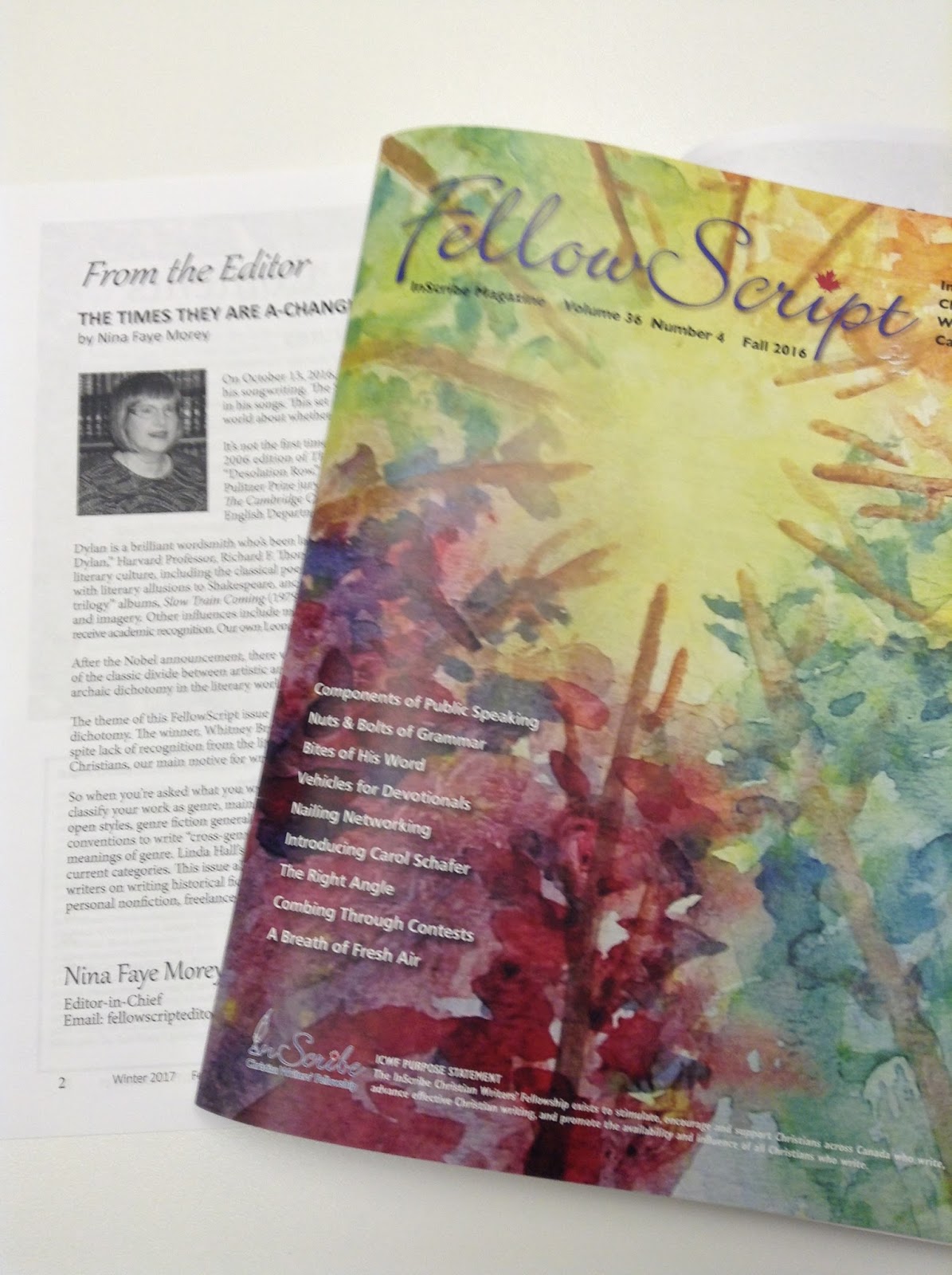
First Magazine as Editor

God was right! Sheila was right! “You took to it like a duck to water,” she remarked later. So I’ve discovered I’m capable of editing a magazine, and I’m feeling comfortable in that role now. I thoroughly enjoy being FellowScript’s editor-in-chief and trust God will continue to give me the ability and strength needed to carry out this special assignment He’s given me.

I can’t wait to cross the next stepping stone He places on my writing path!


Photo Credits: © 2017 Nina Faye Morey


September 14, 2013

What a Funeral Director Taught Me About Writing by Pamela Mytroen

            At a recent interview a funeral director shared five principles for dealing with his clients. They may also work for instilling life into writing:

            1). “Get to know your client,” said the funeral director. Who is a writer’s client? It’s his ideal reader. What issues are your readers facing in their generation?  If you understand their felt needs, you may target your writing more accurately.

            2). Be a good listenerThe funeral director said, “At first let the families talk. Just listen.” This applies well to writing. In fiction, draw up character charts and then have a conversation with your characters. Get to know them. In non-fiction, listen to your interviewees. Find out what makes their heart skip a beat. The more you know them, the better you can represent them on paper.  

            3). It’s all about the details. Certainly in non-fiction this rings true. If you misspell their name or contact info they may never trust you again. If they don’t want certain information in the paper, respect that, even if you think it is less of a story. In fiction the details include a well-drawn character, a fully-realized problem, and a visualized setting. Some novels begin with the details and others start with action. Either way, details are like the clothes on a skeleton: they bring a character to life. (Well, maybe not in the funeral business...)

            4). Acknowledge the heart-beat. The funeral director mentioned that the trend is swinging towards no funeral service. But he feels that everybody, no matter how insignificant or demoralized, deserves acknowledgement that they lived and breathed. In fiction, this rings true for all characters including the villain. If he or she is always portrayed as evil through and through, the common reader can’t relate. All villains have something humane about them and this is what causes us to wonder if they will carry through with their evil plot or not. That seed of humaneness keeps us turning the pages. In non-fiction, it’s that emotion that keeps the reader interested also. Whether the article is about an event or a business interview, it can be boring and dry unless some honest emotion is revealed.  Who wants to read about how to invest and how to build equity? But, if the article highlights one person’s financial journey, their joys, doubts, and victories, the reader is much more likely to stick around. 

     5). "Sometimes you just have to leave the room" The funeral director mentioned that sometimes the family gets distracted with long buried hurt and anger instead of moving ahead with the funeral plans. Do you ever feel that your writing project is stuck and is not moving forward? This funeral director tells his clients that he has some work to do in another room and that he will be back in 15-20 minutes. This is good advice for the writer too. Take a mental or physical break from your writing. When you return to your work you may feel refreshed and see things in a new perspective.


This funeral director seemed to know a lot about infusing life into writing. Try following his advice and people may end up dying to read your stuff.


April 17, 2013

Organizing My Computer by Bryan Norford

I was taught that my desk should show some disorganization. If it was too messy I was not in control of my work, but if it was too tidy, I obviously had nothing to do. Unfortunately, computers do not understand that rule.

Organization is probably the least inspirational part of writing, yet, If we look below the surface, it’s something that still requires inspiration to ensure it works effectively. In fact, inspiration is necessary for every aspect of writing, even the most mundane parts of the work.

To consider that we need not pray about the mundane is to exclude God from the infrastructure of our lives, no more so than in our writing. It’s really pointless praying for inspiration for that perfect piece if it’s lost in a computer maze.

So here are some ideas for organization that I use, and contrary to my previous advice, I spent too little time seeking guidance for—from others or from God!

My Documents library includes many directories, including Articles, Blogs, Books and Diary. Articles is the least organised, simply with all completed articles in alphabetical order. My Diary lists each years’ blogs on Norford’s Ramblings, dating back to 2008, as documents. The Blogs directory list blogs on other sites, including a sub-directory for blogs to Inscribe.

Books is the most comprehensive directory, as that is where most of my time and energy is spent. Each book title naturally has its own sub-directory, but within each of those are the following sub-directories:

0 Original Script: This is kept up to date with the latest revisions.

1 Edited Script: Any scripts edited by others kept for reference.

2 Images: Downloaded images I may use for cover design, and cover design development.

3 Agreements: Publishing or other agreements scanned and kept for reference.

4 Correspondence: Critical letters or emails regarding the book, including endorsements.

5 Published Script: Holds camera ready documents and PDFs of the book for self publishing.

6: and 7: Left free for other directories that may be required for a particular book.

8 Seminars: Holds document and power point presentations for the book.

9 Superseded: Really important: keeps outdated materials separate from current scripts or images, but still available for future reference.

I use numbers for these sub-directories to maintain the order I want, rather than alphabetical order.

Also in the Documents Library I have directories for Invoices, Promotion, and Templates. These are separate from the individual book directories as the contents often include more than one book. At present, I have no sub-directories for these, but as they grow, they may also need subdividing. The Templates directory holds cover or interior templates a publisher may provide or require for processing.

These ideas are, of course, specific to my work, but may be adaptable for your particular needs. If so, I pray that you may be inspired to clean up your computers, and able to access your materials more efficiently—especially that remarkably inspired, but long lost piece!

April 14, 2013

The Business of Writing from the Heart and Writing Short


I’ve learned a couple things from writing the live concert review over the years.

          1) Just start.
          2) Keep it short.
         
It sounds like the perfect sermon.

When I began writing I assumed that before I penned  the first word I needed to do a ton of research to back up my points. I would read for hours, and find all kinds of wonderful and intriguing information. Then I would try to squeeze as much into the article as I could.

But there was a problem with that ‘viewpoint’. Looking back I can see that I was just sharing ‘points’ without my ‘view’. I was dumping knowledge but it probably ended up in the landfill. People aren’t usually impressed by facts.

I feel that people do not read for knowledge as much as they do for affirmation. We read to find ourselves on the page. We are always looking to validate our own unique pilgrimage. Have other people taken similar detours? Have they experienced the same kind of defeats and doubts as we have? If we find ourselves in a story, fiction or non, we feel validated. We find a niche in the spectrum of humanity and so we have hope to continue.

Therefore, when I start an article I pour out my feelings and impressions first. Later, after the first draft, I check my facts and I research to be sure I am credible. Heart first, facts later.

The second thing I’ve learned is to keep it short.  My first human interest story was several pages long in the newspaper. I’m surprised they printed it all! And I’d be even more surprised if anybody actually finished reading the epistle.

I’ve noticed that I like to read really short pieces and if it looks too long I will just skim for key points. Now I aim to treat my readers the same way I want to be treated. Hey, this is starting to sound like a sermon. 

Just get started. And keep it short. 

Pam Mytroen

January 14, 2013

How to Date Your Editor by Pamela Mytroen

Remember your first dates? Do they make you cringe at all? I remember my very first date. We were going to an evening event. I dressed casually in dress pants and a pink sweater. He picked me up in a three piece pin-stripe suit and tie. Awkwaaaaaard! It was too late to go back and change and he said it was okay, but I felt a little funny all evening by his side. The next time we went out we communicated about what to wear and we both felt more comfortable.

The first article you publish in a magazine or a newspaper is a little like a first date with your Editor. You really don’t know fully what he expects of you and he doesn’t understand your style yet. It’s like being picked up in a truck with hay sticking out the tailgate when you were hoping for a Delorean. You read the article you’ve been looking forward to and you turn red and bite your lip.

I look back on some of my first articles and they made me a little disappointed or even upset. One of the Editors took out my last two paragraphs, put her own ending in, and changed the whole style of my article. Another first article came out with several spelling mistakes, and yet another one included a poem that I had not written and it endorsed a false theology. Wow, I felt the heat in my face.

Now sometimes there are unforgivable characters that we must ditch after that first date, but in most cases, it just takes some time and a few fumbled dance steps until we get to know which way the guy is leading. It’s the same with Editors. If we quit writing because of that first bumbling article, we are missing out on what might have turned into a wonderful and profitable relationship.

In looking back on the above mentioned articles I wrote, it wasn’t entirely the Editor’s fault. The blame needed to be shared between both of us. If I had continued writing for these Editors I would have become more aware of their expectations and they may have come to appreciate my style and input as well.

As I consider the newspaper that I’ve written for for several years, I realize that we had some rough moments at first too. We both had misunderstandings of each other. But as I continued ‘courting’ my Editor and sending her more articles, I became more aware of the way she thought about things, and what she valued and wanted from me. I grew to have enough confidence to make suggestions, and we began to trust each other.

Think of your first articles. Were you disappointed and quit writing for that Editor? Maybe it just needed a little more time to work out some of your differences. Have you ever considered going back to write for those markets again? Send the Editor another piece or two. Maybe there’s still a spark there. Just don’t give up after that first date!