August 29, 2012

5 Reasons Writers Should Use Twitter - Ruth L. Snyder

Several years ago I was encouraged to open a Twitter account. I knew I didn't have time to blog regularly and I decided to use Twitter as my "mini" blog. With a bit of trial and error, I learned how to use Twitter. Today I consider Twitter to be part of my professional development. Here are five reasons I think writers should use Twitter.

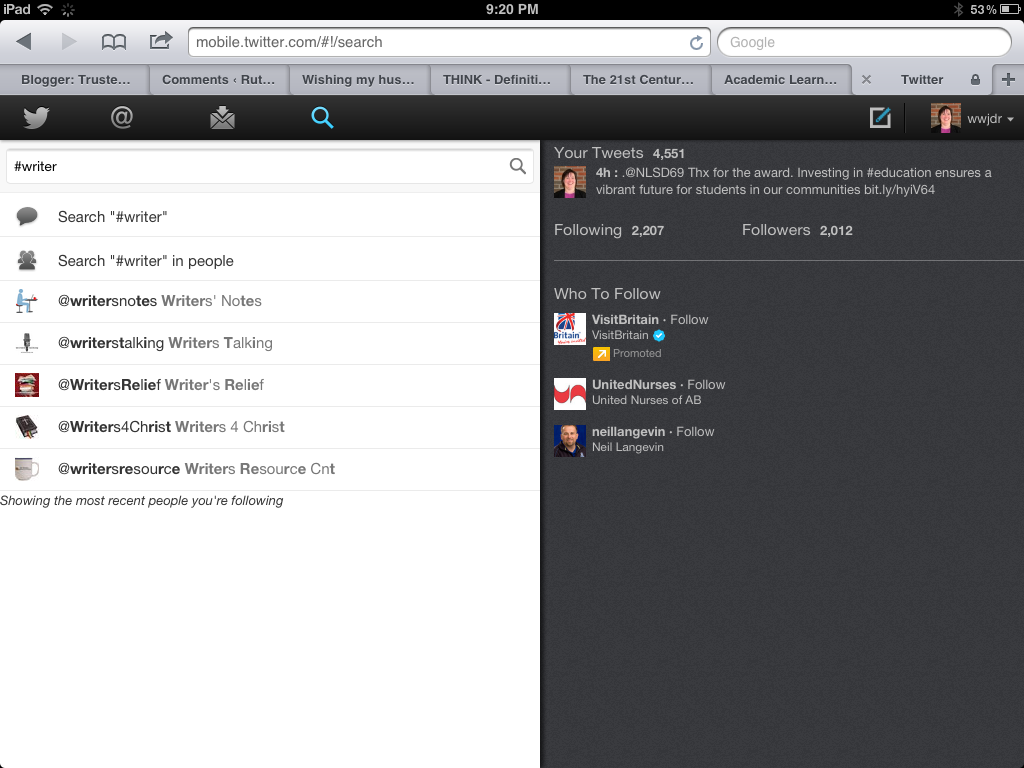
1. Use Twitter to expand your network - Twitter is an easy way to "meet" people with like interests. Find people who are writers by typing #writer into the search bar at the top. You can then read tweets of people who use the hashtag (#) "writer" and decide who you would like to follow. Usually if you follow someone, they will follow you back. People also tend to follow those who share helpful content, so share links to information that you as a writer find interesting. Twitter is all about building "relationships". This takes time. I've been on Twitter for over three years and have about 2,000 people who follow me.

2. Use Twitter to find information and resources - I find that searching on Twitter often yields more useful results than searching on Google or another search engine. Most people with Twitter accounts use hashtags like #amwriting to provide an easy way to "index" or file their tweets and to find tweets on the same subject. Here's a list of helpful hashtags for writers. You may also wish to research specific topics you are writing about. You can type anything into the search feature. If you type something with a hashtag, all the tweets which contain that particular hashtag will come up. All tweets that have a specific word or phrase will come up if you enter it without a hashtag.

3. Use Twitter to share information - If you find a link that is useful to you as a writer, share it with other writers. Perhaps you were inspired by a famous #quote. Others will probably enjoy it too. If someone else tweets something you find helpful, use the "retweet" function to share the information.

4. Use Twitter to build excitement about your next book - The ideas are as limited as your imagination. You can share short snippets from the plot. (Remember that you are only allowed to share 144 characters at a time.) Perhaps you want to introduce readers to your main character and give them some backstory. Tweet when you've finished the next chapter.

5. Use Twitter to build your platform - Michael Hyatt shares why you can't succeed without a platform. If you don't care about having people read what you write, building a platform is not important. However, most of us want to share what we write. You will note that Twitter is only ONE way to build your platform, along with blogging, Facebook, newsletters, and podcasts.

What have your experiences with Twitter been? Have you found it helpful as a writer? I look forward to hearing from you.

Ruth L. Snyder
www.trusteesnyder.blogspot.com (Education information)
www.ruthlsnyder.com (Ruth's writing and family life) 
www.earlyyearssuccess.com (Information for caregivers of children ages 0-5)

Follow Ruth on Twitter:www.twitter.com/@wwjdr

August 28, 2012

HEALING WOUNDED LAMBS -- Bruce Atchison

Acts 20:28-30 (KJV) Take heed therefore unto yourselves, and to all the flock, over the which the Holy Ghost hath made you overseers, to feed the church of God, which he hath purchased with his own blood. For I know this, that after my departing shall grievous wolves enter in among you, not sparing the flock. Also of your own selves shall men arise, speaking perverse things, to draw away disciples after them.

Throughout the Bible, Satan has corrupted and suppressed the truth. He continues today to use people, even professing Christians, to prey upon the flock of Christ. Disguised as shepherds, these phony leaders mislead and abuse their flocks to the point where many sincere sheep turn away from the Good Shepherd.

I was one of many who wound up in a cultic house church. Nobody discipled me when I gave my life to Christ in 1969 at a vacation Bible school. Consequently, I had no discernment skills. The World Tomorrow radio program became my mentor until a friend invited me to his church in the basement of a house.

The self-proclaimed teacher captivated my imagination with his stories and twisted scriptures. As a result, I believed that God lead me to a spiritually-advanced church that knew deep teachings which mainstream churches didn't.

One of these so-called secrets was the naming of Christ's name to cast out demons and heal people. Particularly appealing to me was the idea that I could be healed of my poor eyesight. I could prove to the skeptics that God was real and he still performed miracles through his apostles and prophets. Visions of TV appearances and speaking tours filled my mind as I imagined myself fully healed.

The wolfish side of those false shepherds soon reared its ugly head. Whenever my eyes weren't healed after the laying on of hands, they accused me of having hidden sin, lacking faith, or having un confessed ancestral sins. For more than fifteen years, I struggled to build up my faith and crush all doubts. Nothing I did triggered God's healing power. Because of all the criticism and harsh judgements made against me, I stormed out of that church one June Sunday and turned my back on God for nine years.

I came to my senses when I realized the Lord wasn't at fault. I had been lied to by folks who I thought knew the scriptures better than I. Bible-believing churches and the sound doctrines of biblically-literate radio preachers steadily deprogrammed me of the lies I learned as a young Christian. I now realize that God is sovereign and nothing I could ever do would gain me better sight.

John 9:3 is now my life verse. Through my upcoming How I Was Razed: And How I Found Authentic Christianity memoir, I hope to comfort those wounded sheep who left the Good Shepherd as I did. I want them to know the real Lord, not the signs-and-wonders idol that I once worshipped. May the works of God be manifest in me as in the blind man Christ healed.

For more information on my writing, visit the Bruce Atchison's Books link.

August 27, 2012

Designing a Deadline - Denise M. Ford


When I wrote for a local newspaper I always knew my deadline as the Friday before the Tuesday printing.  Obviously my news for the small town column I wrote didn’t always include up-to-the-minute newsflashes.  Still I appreciated the sense that I had a weekly timeframe to organize my thoughts and ideas.  I fell quickly into a pattern of assembling information, collecting snippets on what shouldn’t be missed for the current week, and obtaining notices of upcoming events.  After placing these in order of importance I would then determine what might be an interesting lead-in to these more mundane items.

Sometimes I would delve into the town’s past history or touch on local legends that could highlight pending festivals.  As such I enjoyed creating ways to enlighten the citizens of my little town and to encourage conversation amongst them beyond the everyday talk about weather, happenings, and calendar announcements.

I thought about this as I began to worry about an upcoming deadline.  I wish this word and its connotations didn’t hold so much power over me, or rather that I wouldn’t allow it to wield control of my days.  How can I begin to let it slide into the sidelines of my thoughts instead of hovering helplessly above me like a huge pail of water balancing on a tightrope, splashing and spitting its contents onto my head. 

Because I am not in the mood for a dousing of cold water, I need to refocus and print another deadline image into my mind.  So I revisit the days when I experienced my first deadlines.  I remember the unequivocal excitement, the careful chosen copy, the enthusiasm expended to entertain.  I specifically recall picturing in my mind the faces of people I knew who would read my column.  I imagined their smiles and nodding heads as they spent a little time rolling my ideas around in their minds.

Fellow writers, I need to reframe the idea of a deadline so that it doesn’t continue to threaten to crash on top of me when I least expect it.  I need to follow a few simple steps that initially kept me focused on the freedom that writing allows; the sheer delight of choosing words to unlock moments of thought in other people’s minds.  I forgot that a deadline isn’t literal.  After our selection of printed copy finds its way onto a page or screen, it hasn’t died.  Every time someone reads it, it comes “alive” in a new way. 

Maybe those drops of water falling from above will begin to cascade on a cooler current, transposing into intricate patterns pushing forth toward perfection.  Ideas freely forming into phrases, sentences, paragraphs, articles, stories, shared thoughts.  Words that will be picked up, presented to and partaken by persons I can only hope to perceive.


To read Denise's personal blog and writing website go to:   http://www.walkingwithdustyanddee.com/

August 24, 2012

Love the Wounded -- Lynn Dove

I suppose it was only fitting that I wrote the last chapter of my book, "Love the Wounded" on Valentine's Day.  I suppose that had to be a "God thing". It was the last book in the "Wounded Trilogy".

As I punched out the last few lines and pressed the "saved" button, I just slumped in my chair and whispered "Done!" My husband and kids were long since in bed, but I was on a roll and just couldn't stop the flow of words. I was so close to finishing, so I plugged on and that's why at just before midnight I celebrated quietly alone in the dark by my keyboard after I had typed the last word of my story. I guess after such a long labour, pouring my heart into a project that started with my first book in the "Wounded" series nearly four years ago, to the completion of the manuscript for the final book, I couldn't help feeling a bit contemplative about it all.

God led me on this writing journey and to tell the honest truth I had no idea then how many curves in the road there would be and what varied adventures waited for me around every corner.

My writer's life has been for the most part a solitary one. It's basically me parked in front of a computer screen, tapping out a plotline that is only imagined in my mind and then brought to "life" on paper. It's a weird process really. It's even more weird when I consider all the other bizarre imagery and thoughts also rattling around in my head at the same time that I could have just as easily regurgitated to life and then instantly regretted. Silly, stupid, and basically messed up things that really should NEVER be put to paper. Fire yes,...paper...no!

James 3:1 says that "not many of you should presume to be teachers, my brothers, because you know that we who teach will be judged more strictly."

I dare say that a writer in many ways is a teacher, especially those of us who are called by God to write. Our words may teach, empower, embolden, condemn, accuse, uplift, benefit and reprimand. Look at history. Mein Kampf caused an entire nation to embrace the ideology of a madman. The book, 1984 by George Orwell coined the phrase "Big Brother is watching you." - a phrase that takes on new meaning today in this world of interconnectedness on the internet. The word "Twilight" will no longer be just a time in the day to sit and watch the sun go down, but now will be forever associated with vampires and werewolves. Even a simple journal, found after a young girl's death, has become a symbol of racial persecution, something the young Anne Frank likely never would have imagined as she wrote her private thoughts into her diary.

Books have the ability to change lives, change history, change the world. It is no wonder that when we writers put pen to paper, or in this day and age, PDF's to Kindle, we must be constantly aware that we will be held accountable one day for what we write.

Now I would be incredibly egotistical to think that my little books will someday "change the world"...Whoa! Still, whenever one person picks up and reads one of my books, whatever I have written will likely elicit a response...good, bad or indifferent in that person. No doubt when I look at my reviews later I will be able to determine what the ultimate response has been...heeheehee :)

So as I "birth" another book I hope you will allow me the artistic license this one time to change the wording in James slightly to keep me ever mindful as a writer Whose I am:

"Not many of you should presume to be (writers),...because you know that we who (write) will be judged more strictly."