Showing posts with label Nina Faye Morey. Show all posts

August 30, 2024

Soul Food by Nina Faye Morey


In her July 19th post, “Soul on Fire,” Tracy Krauss comments on the passion for writing expressed by so many of the contributors to InScribe’s new anthology, Creativity & Chaos: Artistic Endeavours for Trying Times. You can check out her interviews with them on our InScribe YouTube Channel at https://www.youtube.com/@ICWF-Canada

“Soul on Fire” is a perfect descriptor for the creative passion on display in this fifth anthology published by InScribe Christian Writers’ Fellowship. Another term I would associate with this anthology is “Soul Food.” Soul food is the comfort food African Americans created in response to the oppressive and troubling times they have experienced, and unfortunately still often experience, in their lives. It is also an apt description for the nourishment of the soul our anthology contributors tell us they derive from their creative responses to the chaos and crises they’ve endured in their lives.


Here are just a few of the talented writers you will find in the pages of Creativity & Chaos: Phil Callaway, Ruth L. Snyder, Valerie Ronald, Brenda Leyland, Sandi Somers, Carol Thornton, Sally Meadows, Carol Harrison, Marnie Pohlmann, Tracy Krauss, Lorilee Guenter, and Barbara Fuller. Their enormous and diverse creative talents are on display in fiction, creative nonfiction, nonfiction, devotionals, reflections, memoir, and poetry, as well as in the creative projects described in the section on hobbies & home.


Are you struggling with overwhelming stress, pain, and chaos in your life? In Creativity & Chaos: Artistic Endeavours for Trying Times, you'll discover the many ways contributors use the creative process to cope with all that negativity and transform it into something positive. If you want to break the chain of negativity and live the abundant life Christ desires for you, InScribe’s brand-new anthology will help you:

Learn coping skills to deal with life's crises

Become empowered to transform your life

Go from surviving to thriving

Use your God-given gifts to feed your soul and spirit

Rekindle your passion for life


If you are eager to see how your fellow InScribers use their creativity to cope with life’s challenges, Creativity & Chaos is now available. InScribe members can purchase their paperback copies for the special preorder price of $15 (plus shipping and handling if applicable) until September 15th at https://inscribe.shelbynextchms.com/external/form/a6014bdf-4ade-41b0-87a6-5d411d70827f  Copies will also be available at this price during the book launch at our 25th Anniversary Fall Conference in Calgary, September 26-28th. After the Fall Conference, paperback copies will be released at a higher price on Amazon. The eBook version will be released on September 9th and is currently available for the pre-order price of $0.99 on Amazon at https://a.co/d/2ZoUmof

I hope you will be as entertained, inspired, and blessed by these stories, essays, and poems as I and my editorial team were while putting this anthology together. And as Barbara Fuller so eloquently wrote in her introduction to this anthology, “Our prayer is that the God who spoke into the chaos of darkness and created all things will be glorified through this creative offing.”

I want to conclude with a quote from Phil Callaway’s “Words of Gold” that appears in the Reflections Section of Creativity & Chaos: Artistic Endeavours for Trying Times and fitly illustrates this post’s “Soul Food” theme and the words of comfort and nourishment for your soul that you will find in the pages of this anthology.

“We, too, can deliberately choose to use precious words of gold to affirm and uplift others …They may be exactly what someone needs to hear, and they could be life changing.” 


Nina Faye Morey is InScribe Press Coordinator, Managing Editor of Creativity & Chaos: Artistic Endeavours for Trying Times, and Columns Editor for InScribe’s FellowScript magazine. She’s also a contributor to this anthology, as well three previous InScribe anthologies: 7 Essential Habits of Christian Writers (2015), Christmas: Stories & More (2017), and Easter: Stories & More (2021).


October 01, 2021

When You Encounter Interruptions by Sandi Somers

Interruptions stop us...

We’re all familiar with interruptions.

They may be small interruptions: a phone call or text message or visitor at our door while we're trying to write. A friend who wants our attention when we’re busy. Someone who interjects their own opinions while we’re speaking. These interruptions can detract us from the focus/task at hand.

Interruptions may be of intermediate seriousness. This summer I was mentally drained from taking writing courses with their demands of weekly assignments, longer essays, and lots of reading. So from May to August I couldn’t write. The ideas didn’t come. Sometimes I felt I had lost four months of writing time.

However, major, life-changing interruptions out of our control can rock our world —and shatter our daily life, our hopes, and dreams.

Last year Tracy Krauss spent time in the hospital with continuing health issues, and over the year she was forced to scale back her responsibilities. “Limitations are my new realities,” she wrote.

Nina Faye Morey’s life was interrupted last year when her husband passed away. Unfortunately, it washed away all those familiar roads in my life, leaving me to tread a lonely and solitary path through the wilderness,” she wrote.

Katie Gerke, one of our occasional bloggers, has written how MS has robbed her of most of her mobility and dreams for the future. And now in the last two months, she has been in and out of the hospital, including in ICU, dealing with various health issues (but not Covid so far). Over her years with MS, she has dealt with debilitating pain and weariness, isolation, and sometimes overwhelming sadness.

When we are interrupted, we may at first be disoriented. Bewildered. Angry. What we thought were our next plans have been halted; something or someone we love is lost with nothing to replace it, nowhere to go.

“The major problem of life is learning how to handle the costly interruptions,” wrote Martin Luther King. “The door that slams shut, the plan that got sidetracked, the marriage that failed. Or that lovely poem that didn’t get written because someone knocked on the door.”

Yet often these are God's interruptions that come from His love. They come for a purpose and plan. “My whole life I have been complaining that my work was constantly interrupted until I discovered the interruptions were my work,” Henri Nouwen wrote near the end of his life.

During this time God may bring us to a place of complete dependency on Himself, a place where he shows us his tenderness. He speaks comfort, promise of his presence and rest. "I will make the Valley of Trouble a door of hope", He says (Hosea 2:15)

I learned this summer that “to everything there is a season” (Eccl 3:1). What appeared to be an interruption to my writing was an intervention. God knew I needed time to rest, to turn my attention to other things…beside writing…working in my yard and garden, taking long walks (the outdoors always rejuvenates me), catching up on visiting family and friends when Covid restrictions eased, and relaxing with God in the early morning. Finally as August progressed, I felt writing sparks began to flicker.

Tracy discovered a door of hope as she wrote: “As God continues to give me clarity about what I am to be doing right now in this stage of my life, I cannot continue to look back and long for how it used to be.” But she adds that God still has a plan and purpose for her, “I have more books to write, grandchildren to snuggle, people to encourage, and interceding to do, but perhaps not at the same pace.” 

Nina absorbed meaningful quotes on grief and thoughts from scriptures, which she shared with us. To restore some semblance of normalcy, she began to write again, also knowing that “creative activities are positive ways to cope with negative feelings and emotions.” She also looks forward to being reunited with her husband and meeting Jesus one day. 

Katie finds God’s hidden treasures as she lives with MS. She wrote that especially in her darkest days, “God shows Himself in light, so brilliant and breathtaking that I will take it and tuck it in my heart so I can use it ‘as a lamp to my feet and a light to my path’” Psalm 119:105.

“Interruptions (are) God's appointments." Debbie Macomber

And now it’s your opportunity.  

 How can you grapple with CS Lewis’ advice: “The truth is of course that what one calls the interruptions are precisely one’s real life – the life God is sending one day by day”?

How has God shown Himself to you in these interruptions?

Has your interruption turned into an opportunity—if so, how?


February 12, 2021

Writing My Way Through Grief by Nina Faye Morey


My life has changed dramatically since I lost my loving husband and soulmate to cancer in April. Since then, I’ve found myself wandering through a desolate landscape filled with grief and loss, searching for the light that will lift me up out of this deep well of darkness.

I know that I must adapt my life to this new and challenging landscape, but my negative feelings—grief, fear, worry, anxiety, depression and loneliness—have caused me to lose my way. These debilitating emotions have also made it next to impossible for me to write. However, I’ve slowly come to realize that if I can refocus my writing to address my grief and loss, it may shed some light on my feelings that will help me work my way through this grieving process.

The empty page seems like a safe and comfortable place to pour out my feelings, but it requires a willingness to delve deep into this darkness that envelopes me. I will need to face my feelings of grief and loss, my fears, my worries, and my anxieties. I’ll need to summon the inner strength to explore and deal with the overwhelming emotions that writing about my grief evokes. I know it will not be easy. But if I’m brave enough, the process of writing may offer some relief from my sorrow and provide the healing needed to find my way out of this deep well of darkness.

While writing my way through grief may offer some measure of release and healing, my main source of comfort still comes through Bible study and prayer. I know that I do not have to deal with these feelings of grief and loss alone. Psalm 34:18 (NIV) assures me that “The LORD is close to the brokenhearted and saves those who are crushed in spirit.” I can rely on Him and His word to provide me with the comfort, peace, strength, guidance, and support that I need. Jesus promises “Blessed are they who mourn, for they will be comforted” (Matthew 5:4). If I pour out my grief to Him through prayer, I know that He will be faithful to heal my broken heart and bind up my wounds (Psalm 147:3). When I am afraid, I can ask Him to calm my fears and give me “the peace of God, which transcends all understanding (Philippians 4:7).

Although writing my way through grief may be therapeutic, helping me to cope with my negative thoughts and feelings, I know that ultimately it is through faith and prayer that God will rescue me from this deep well of darkness and lift me up into the glory of His light once more.

December 16, 2020

Lift Your Voice in Songs of Praise by Nina Faye Morey


Let the word of Christ dwell in you richly;

teach and admonish one another in all wisdom;

and with gratitude in your hearts sing psalms,

hymns, and spiritual songs to God.

~ Colossians 3:16


Have you been brave (or perhaps foolhardy) enough to be out and about shopping for gifts this Christmas season despite the current Covid-19 Pandemic? I completed all of my Christmas shopping armed with my face mask and lots of hand sanitizer. But now the Saskatchewan government has restricted us to members of our own household. So Christmas celebrations with my daughter and her family, who were planning to travel here from Alberta, will be placed on hold for the foreseeable future. Their gifts have now been stored away, and cards with a little something tucked inside have been delivered. At least, as the only person in my household, I’m allowed one guest, so I’ll still be able to celebrate with my son who lives nearby.

If you have gone out Christmas shopping this year, whether you’ve visited the huge shopping malls or just frequented the little gift shop around the corner, you’ve no doubt been either entertained or exasperated by the constant refrain of familiar Christmas carols. If, like me, you fall into the entertained category, you probably know most of the words to these carols and enjoy cheerfully singing or humming along.

No matter what troubles I might be dealing with at that moment, whenever I hear voices raised in hymns of praise to my Lord, I always experience feelings of love in my heart, joy in my spirit, and peace in my soul. These well-known and well-loved carols that Christians sing during the Christmas season are really inspirational hymns that express our love for Jesus and our thanks to God for His glorious gift.

Have you ever been curious, as I often have, about what inspired those creative songwriters to write their Christmas carols? My curiosity led me to look into the lives of some of these gifted hymn writers to find out the stories behind their expressions of praise to the Lord that I’ve listened to and sung along to for many joyous Christmas seasons: Martin Luther, father of the Reformation; Charles Wesley, co-founder of Methodism; and John Mason Neale, recognized Anglican minister and poet.

In the 1500’s, congregational hymn singing flourished under Lutheranism. Martin Luther was an Augustinian monk; his wife, Katharina Von Bora, belonged to a cloister of nuns. When these nuns sought Luther’s help to escape the confines of their convent, he recruited a nearby merchant to smuggle them out in the empty barrels from the pickled herring he delivered. Luther successfully arranged marriages for all but the young, bright, and spirited Katharina. When Luther teased that he might have to marry her, his father encouraged the match. After they wed, they moved into a former Augustinian monastery on Wittenberg’s main street.

Soon their son, Hans, arrived and Luther was an adoring father. He wrote Hans a children’s Christmas carol, “From Heaven Above to Earth I Come.” The couple sang this renowned Lutheran carol with their children every Christmas Eve. A contemporary songbook entitled Dainty Songs for Little Lads and Lasses, also contained another carol written by Luther that’s been one of my favourites since childhood, “Away in a Manger.” Its compiler, James R. Murray, referred to this carol as “Luther’s Cradle Hymn.” His citation read, “Composed by Martin Luther for his children and still sung by German mothers to their little ones.” Although its authorship has been disputed, many still credit Luther with writing this popular children’s carol.

Congregational hymn singing continued to thrive in the eighteenth and nineteenth centuries. During his years of itinerant ministry in England and America, Charles Wesley, co-founder of the Methodist movement, constantly composed hymns as he completed his “circuit” on horseback. Requiring no specific creative inspiration, Wesley composed approximately 6,000 hymns during his lifetime.

Wesley was always adamant that others reprint his hymns exactly as he had written them. Fortunately, his old friend and fellow preacher, George Whitefield, wisely rewrote some of the lines from Wesley’s 1739 carol, “Hark! The Herald Angels Sing,” to create the now familiar version he reprinted in his 1753 collection. This is one of my all-time favourite Christmas carols. Its rousing verses never fail to lift my spirits.

As a recognized Cambridge scholar and poet, John Mason Neale dedicated himself to the preservation of ancient churches and medieval “songs of praise.” He translated several Medieval Latin and Greek hymns into English and recovered several segments of Latin responsorial songs that he combined to create the Christmas carol, “O Come, O Come, Emmanuel.” His research also led him to write a translation of the fourteenth-century hymn, “Good Christian Men Rejoice.” His devotion to charitable work resulted in the poem, “Good King Wenceslas,” in honour of this medieval king’s Christian charity.

We Christians, despite our diversity, are united in fellowship every Christmas by our love for these carols. These melodious hymns provide a means to convey our heartfelt gratitude for Gods’ glorious gift of redemption and abundant life through His son, Jesus Christ. So in this spirit of unanimity, let us proclaim our love for our gracious Lord and Saviour by lifting our voices in “songs of praise” this Christmas season.


November 15, 2020

A Season of Mourning by Nina Faye Morey


The word I chose for this year was preparation. The title of my January post was “A Season of Preparation.” I talked about how winter is a season of preparation that helps us grow stronger to withstand the upcoming storms. The impending storm I saw on the horizon then did not pass me by as I’d hoped. Unfortunately, it washed away all those familiar roads in my life, leaving me to tread a lonely and solitary path through the wilderness.

Some seasons are too short, while others seem to cling to life forever. Sadly, my season of preparation was briefer than I’d expected or needed. Although I knew my husband’s cancer was terminal, his remaining time was cut way too short. When I sent him off in the ambulance the night he passed, I thought he’d be admitted to the hospital, hopefully, the Palliative Care Unit. When the ER nurse phoned me in the wee hours to tell me he wasn’t going to make it until morning, I had to ask her to repeat what she’d said. I couldn’t believe what I was hearing. Unfortunately, he was already unconscious by the time I got there, so I never said my goodbyes as I’d planned.


Turn to me and be gracious to me,

for I am lonely and afflicted.

Relieve the troubles of my heart

And free me from my anguish.

~ Psalm 25: 16-17 (NIV)


Since then, I’ve relied on the Lord to give me the strength I need to cope with the grief, fear, sadness, and loneliness that accompanies this new season of mourning. I continue to pray and take comfort from the knowledge that He’s always with me to bear me up no matter what troubles I’m experiencing.


Grief comes in and out like waves from the ocean. Sometimes when you least expect it, a huge wave comes along and pulls your feet right out from under you.

~ Alan Wolfelt, Understanding Your Grief


There are good days and bad days. Some days, I feel pretty good. Other days the tears come in waves, triggered by seeing or hearing something that reminds me of my husband or a special day we’d normally celebrate together. You can’t stop these waves of grief any more than you can stop the storm waves rolling in from the ocean. I doubt anyone can ever be truly over their grief. It will always remain with you, but somehow you gradually learn to make peace with it and go on living.


In grief, nothing “stays put.” One keeps emerging from a phase, but it always recurs. Round and round. Everything repeats. Am I going in circles, or dare I hope I’m on a spiral? But if a spiral, am I going up or down it?

~ C.S. Lewis, A Grief Observed


Psychologists talk about the five stages of grief: denial, anger, bargaining, depression, and acceptance. But not everyone goes through all of these stages in sequential order or even experiences them all. The grief process doesn’t proceed in sequential stages; it’s a wild, up and down roller coaster ride. There are days I feel I’m functioning normally. Then there are days I’m totally absent minded and forgetful, I have trouble concentrating, or I do or say something that’s stupid or crazy. Those days make me think that I’m losing my mind. (Especially scary, since my father and other members of his family suffered from Alzheimer’s disease.)


When we lose someone we have loved deeply, we are left with a grief that can paralyze us emotionally. …When they die a part of us dies too.

~ Henry Nouwen, Bread for the Journey


After the loss of my husband, all my preparations and plans for 2020 never had a chance to even bud, let alone bear fruit. I’d planned to spend more time on my writing, but I lost all motivation to write. Even now, it remains elusive. But, I’ve forced myself to at least pick up the pen to write these posts in order to restore some semblance of normalcy to my life. I also know that creative activities are positive ways to cope with negative feelings and emotions.

The main thing I’ve learned is that you’re never prepared for the death of a loved one, or the loss and grief that follows once the initial shock has passed. Death does not “go according to plan.” My husband died during the wee hours of the same morning Palliative Home Care had arranged to deliver a lift chair and install poles to help stabilize him so that he could get up out of the chair, bed, and shower. Although we’d made our funeral arrangements several years in advance, there was still the actual funeral service to prepare. During his illness, we’d discussed my handling of the finances and many of the normal affairs of living. I’d taken over driving and some of the practical day-to-day chores. But I wasn’t prepared when it came to doing all of the things my husband normally took care of, such as snow shovelling, minor household repairs, or vehicle maintenance.


“Though the mountains be shaken

And the hills be removed,

Yet my unfailing love for you will not be shaken

Nor my covenant of peace be removed,”

Says the LORD, who has compassion on you.

~Isaiah 54:10


Those are just some of the practical preparations, but there’s also many on the spiritual side. It’s normal to be sad, anxious, afraid, and lonely when your spouse dies. It’s one of the most difficult passages in life. But I continue to pray, read scripture and spiritual texts, and keep my thoughts on my Lord and Saviour. I’m looking forward to being with both Jesus and my husband in heaven one day. That helps to give me some sense of peace, hope, and comfort throughout this very difficult passage in my life.


March 16, 2020

What are You Giving Up for Lent? by Nina Faye Morey


It is written: ‘Man shall not live on bread alone,
but on every word that comes from the mouth of God.’
~ Matthew 4:4 (NIV)


The concept of Lent runs contrary to our mainstream North American culture. We live in a society that prides itself on having plenty, and we’re driven by an insatiable need for immediate self-gratification. We constantly run to and fro, pride ourselves on always being busy, and our lives are full of stress.

However, Lent should mean much more to us than just another ritualistic event in the liturgical calendar that we must dutifully observe. It is meant to be a solemn season of reflection, prayer, penance, self-denial, and spiritual preparation for Easter. We are to deprive ourselves of something we hold dear in recognition of the ultimate sacrifice Christ made for us on the cross—His life for ours. We are also to share in the suffering and self-sacrifice He endured during those long 40 days spent in the desert depriving Himself of any form of sustenance (Luke 4:2, Matthew 4:2). That is the origin of the Lenten tradition of commemorating our Lord’s suffering and sacrifice with a forty day period of fasting.

We get several perspectives on this practice of fasting from the Bible. It can be practiced for a variety of reasons, but it’s usually interpreted as a complete abstinence from food from morning until evening as a means of seeking the Lord through reflection and prayer (Daniel 9:3). Fasting is observed on the Day of Atonement as an expression of sorrow and repentance for sin (Leviticus 16:29-30). Fasting and prayers are also used to petition for God’s intervention. David’s fasting and prayers were a plea for God to spare the life of his child (2 Samuel 12:15-17.22).

I must admit that I don’t always observe the season of Lent. Not having grown up observing this religious tradition, it often passes by without my giving it the consideration it deserves. It will be half over before I overhear it discussed in other’s conversations or someone asks me that inevitable question, “What are you giving up for Lent?” Then rather embarrassed about my laxity, I’ll commit, rather late in the season, to deprive myself of something that I would normally enjoy indulging in.

I don’t pretend to have the willpower to fast completely for 40 straight days like our Lord Jesus. However, I have often committed to fasting for one or two days a week during Lent, allowing myself only the conventional small evening meal—meatless if it happens to be a Friday. Although for several years now I’ve been mainly a vegetarian, so perhaps I shouldn’t really count the latter as a sacrifice. Although Ash Wednesday and Good Friday are supposed to be full fast days, I confess they are not always ones I’ve managed to strictly observe. Nevertheless, fasting does seem to have become my usual form of sacrifice for Lent.

One other Lenten sacrifice I’ve occasionally observed is giving up all fast food for the duration. I attempted that one last year but lost the battle mid-April during a visit to A&W with the grandchildren. Sweets and deserts are another indulgence that I’ve managed to successfully sacrifice—with the exception of chocolate. I have also considered sacrificing my morning coffee for Lent, but have so far failed miserably to develop the degree of self-control that requires. I suppose if I tried a little harder, I could come up with more cravings or desires that I might forgo to remind myself to focus more on prayer and spiritual matters during this period of penitential preparation for Easter.

Recently, I read about someone choosing to give up all forms of social media for the duration of Lent. I thought that sounded like a great idea at first, until I realized that I don’t actually engage often with social media. So, I guess I couldn’t really count that as a meaningful sacrifice. As Bob Jones mentioned in his blog, I’ve also considered giving up TV watching for Lent. But I haven’t yet mustered up the fortitude required to give up my favourites—the movie channels and various news programs on CNN, CBC, CTV, BBC, CNBC . . . umm, better make that my addictions!

But perhaps the best suggestion I’ve read for observing Lent is to put the focus on others rather than on ourselves. This form of “fasting” would involve sacrificing our time and talents to undertake such things as working towards remediating the injustices of hunger and homelessness, offering help and healing to those in need, donating clothing to a thrift shop, or making amends for any wrongs or sins we’ve committed.

Whatever form of fasting we choose to observe for Lent, Jesus reminds us that our fasting is not to be a viewed as a prideful exercise of show and tell (Matthew 6:16-18). Rather it is a time for us to pray, to ponder our sins, and to turn to God in genuine repentance.

What form of fasting will you practice this Lenten season?


January 16, 2020

A Season of Preparation by Nina Faye Morey


Forget the former things;
do not dwell on the past.
See, I am doing a new thing!
Now it springs up; do you not perceive it?
I am making a way in the wilderness
and streams in the wasteland.
~Isaiah 43:18-19 (NIV)


In the dead of winter, snow blankets the landscape from horizon to horizon. There is no evidence of any flora budding, growing, or maturing in this vast winter wasteland. The prairie appears to lie silent and dormant. However, don’t be fooled. Winter is actually a season of preparation, when trees, grass, and various plants get ready to spring up anew once the strong sunshine, warm weather, and bubbling streams return. Plant life needs to hibernate beneath its warm winter blanket in order to gather strength to withstand the storms that will inevitably arrive with the new seasons of growth and harvest.

The coming of the New Year, which in our part of the world comes in the dead of winter, is also typically a time of preparation and renewal when people set new goals for the upcoming year. Hopefully, this time of preparation will help us grow stronger so we can withstand any upcoming storms and handle whatever future God has in store for us.

My Personal & Faith Life: Preparations & Prayers


As the New Year begins, I find myself living in a state of uncertainty and apprehension. There are ominous signs on the horizon of an impending storm that could wash away familiar roads, leaving me to tread a solitary path through the wilderness. I pray this storm passes me by, leaving my familiar landscape unscathed. Despite my fears, I am comforted by the knowledge that God holds my future in His hands. Therefore, I will prepare for whatever may come my way by continuing to pray and to place my trust in Him. I will take reassurance from His promise to be with me, strengthen me, and take me by the hand and bear me up in times of trouble.

So do not fear, for I am with you;
Do not be dismayed, for I am your God.
I will strengthen you and help you;
I will uphold you with my righteous right hand.
~ Isaiah 41:10

My Writing & Editing Life: Preparations & Plans

I’ve planned a few changes and set some new goals for my writing and editing life this year. As some of you already know, I will be stepping down as editor-in-chief of FellowScript following the publication of the May issue. However, I am preparing to take on a new challenge, serving as the managing editor for InScribe’s 2021 anthology, Easter: Stories & More. I am excited to be taking on this new role, and I look forward to working with our InScribe family of talented writers and editors and to helping the InScribe Press Committee put together another inspiring anthology.

I am also preparing to devote more time to my own writing. I hope to finish revising the draft of my romance novel and to publish a collection of my published work (along with a few unpublished pieces). While I’ve loved serving as FellowScript’s editor-in-chief and feel fortunate to have done so, my work on these books has dwindled to a mere trickle. Hopefully, I’ll be more successful at juggling my new editorial commitments with my own writing goals this year.

Also, in addition to posting monthly on this blog, my plan for the upcoming year is to publish a weekly post on my own blog, Writer Ink Well. However, I confess I’ve already missed that target. I especially enjoy interviewing fellow writers for my blog, and I plan to also offer opportunities to guest post. If you’re willing to be interviewed or you’d like to write a guest post for my blog, please feel free to contact me.

Those are the preparations and plans I’ve made for this year. What preparations have you made and what have you planned for 2020?


Nina Faye Morey is a Canadian writer, editor, blogger, and speaker. She’s had fiction, nonfiction, poetry, and art published in a variety of journals. She’s also contributed to two InScribe anthologies: 7 Essential Habits of Christian Writers (2015) and Christmas: Stories and More (2017). Nina’s served as columns editor for InScribe’s FellowScript magazine and is currently the editor-in-chief. When she’s not writing, she enjoys reading, walking, travelling, and spending time with family.

December 16, 2019

Just the Right Christmas Gifts by Nina Faye Morey


And don’t forget to do good and to share with those in need.
These are the sacrifices that please God.
~ Hebrews 13:16, NLT

“Christmas is almost here,” Gloria sighed, “and I haven’t bought a single gift! Everyone has everything they could ever want or need. What could I possibly give them?”

“Really!?” Nancy said to her friend. “With all those store shelves overflowing with everything imaginable, you can’t find one single gift for anyone?”

“Well,” Gloria protested, “What could I give momma? I’ve wracked my brain and can’t come up with a single thing. She has all kinds of necklaces, and bracelets, and rings. So I can’t give her jewelry. She’s got a closet full of clothes and shoes, so there’s no use buying her those. And she’s got bookshelves bursting with books she still hasn’t read. So I can’t buy her any more books. Can you see my dilemma, now?”

There was silence for a moment, while Nancy considered this.

Undeterred, Gloria continued with her rant. “Then there’s my sister, Carrie, and brother, Larry, and all my cousins. They’ll come bearing a bunch of presents Christmas day, and I haven’t the foggiest notion what to get any of them. I’ve got to get them all something! I’d like to find just the right gifts for each one, if I could just figure out what that might be. I do love receiving presents, but I sure hate giving them!” she finished in a huff.


“Well!” said Gloria’s grandmother, who’d been listening in on the girls’ conversation. “When I was your age, I was happy to get any Christmas presents. My family was going through a difficult time, and there wasn’t much money to spend on gifts. I remember getting a Christmas stocking with a single orange and a few pieces of candy, and I was perfectly happy.”

“It would be a whole lot simpler if that were my problem,” Gloria sighed, “I’ve a list full of people with more than they know what to do with, but I still have to find them a gift they’ll absolutely love.”


“Didn’t they appreciate the presents you bought them last year?” Grandma asked.

“No, I don’t really think so. At least I could tell Auntie Susy didn’t care that much for the ring I gave her. And I tried so hard to find something really nice to give her because she always buys me such a lovely present each year.”

“Well, if you want someone who’ll appreciate your efforts, I know of several needy families who’d be easy to please and delighted to receive whatever gifts you gave them.”

Nancy piped in enthusiastically “Now, that’s a wonderful idea! Don’t you think so, Gloria?”

Gloria pondered this for a minute. “Yeah, that sounds like a lot more fun and a very worthy cause, too,” she agreed. “Who are these needy people, grandma?”

“Yes, please tell us!” Nancy chimed in. “I’d love to buy them some gifts, too.”

“Well, there are families from our church who wouldn’t turn up their noses at any gifts you gave them,” Grandma said. “For instance, you know Carla, right?”

“Of course, grandma, she’s one of our friends from Sunday school.”

“Well, her father recently lost his job and her mother’s too sick to work. They barely have enough money to put food on the table, let alone buy a turkey and all the trimmings for Christmas dinner. They certainly won’t be able to afford a nice present for Carla this year.”

“Oh, no, that’s terrible!” Gloria said.

“Perhaps you girls could put together a nice Christmas hamper for them and buy a little gift for Carla?” Grandma said.

“Yes, that’s a wonderful idea, grandma,” Gloria said. “We could buy them a turkey and potatoes and canned vegetables and crackers …” Gloria counted these items off on her fingers.

“But you mentioned there were several families who could use gifts,” Nancy broke in. “Who else could we buy presents for?”


“Well, there’s a single mother with a little girl who was telling me she doesn’t know where she’ll find money to buy a tree, decorations, or presents this year. Perhaps you could purchase a small tree, a few ornaments, and some little gifts for them.”


“Oh, I’d love that, grandma!” Gloria cried. “I’ve never bought a Christmas tree before. Could we go buy one right now before they’re all picked over, please?”


“Well, hold on just a minute,” said Grandma. “If you girls go ahead and do this, will you still have enough money left over to buy some nice presents for your family?”


“Yes, I think so, Grandma,” Gloria said. “And I really, really do want to buy some nice presents for these needy people.”

“And I have quite a lot of money saved up to help out, too,” offered Nancy.

“Well, I’ve a few dollars tucked away that I could contribute to such a charitable cause,” said Grandma, “so let’s go shopping this afternoon.”

The two girls jumped up and down and clapped their hands with glee.

Grandma’s heart was gladdened by the girls’ generosity. “I’m so proud of you girls! Instead of wasting your money on extravagant and frivolous gifts, you’ll be purchasing something that’s really needed. These people will be so grateful for such gracious gifts given out of the goodness of your hearts. And I know Jesus will be very pleased, too, that you remembered the poor and needy on His birthday.”

November 16, 2019

Celebrate Each Step Forward by Nina Faye Morey


“Breaking big dreams into small steps is the way to move forward.”
~ Sheryl Sandberg

I was in my early fifties when I seriously began my writing journey. Writing was a life-long dream, but doubts lingered. What if I don’t have what it takes? What if I’m not good enough?

As a teenager, I had some poems and stories published in the Western Producer’s “Young Cooperators Club.” But before long, I became preoccupied with other things and didn’t pursue my passion again until midlife. My first query letter went to the “Farmlife” editor of Grainews. To my astonishment, she called to encourage me to send in my story. I worked hard on it for several weeks and submitted it before the deadline. She accepted it for publication! Celebrate, celebrate, dance to the music!


Since then, I’ve progressed step by step in my writing, publishing articles, short stories, and poems in various publications. I’ve received writing awards and the Barnabas Fellowship from InScribe, published stories in two of their anthologies, presented workshops at their conferences, and served as the columns editor and editor-in-chief of their FellowScript magazine. Two novels and a collection of my published writing are current works in progress.


Thomas Carlyle said, “Nothing builds self-esteem and self-confidence like accomplishment.” Each small step taken in my writing journey boosts my courage, and each successful step forward earns me the right to celebrate. So I give myself permission to do my little victory dance! It’s something I’d highly recommend. But if you have two left feet, here are a few other ways to celebrate success:


Celebrate your success with a commemoration. Commemorate your published work, positive reviews, and writing awards in some way. Frame that book cover or writing award and hang it on your wall; print out that admiring email from a fan and keep it in your journal; place that favourable review alongside your piece in your writing portfolio and post it on your website. These commemorations remind you of your successes and boost your confidence whenever you become discouraged or feel like a failure.

Celebrate your success with others. Share your success stories with family, friends, and the larger writing community. Call or email them, post announcements on your website, or share the news with your followers on social media or through newsletters. Don’t forget to thank those who’ve supported you along the way. Take them out for dinner or throw a celebration party.

Celebrate your success with someone else’s creation. Replenish your creative energy by enjoying someone else’s creation. Read a favourite author’s novel, watch a favourite movie, or gorge on a favourite bakery’s confection. Go ahead, don’t feel guilty. You’ve earned it!


Celebrate your success with a present to yourself. Gift yourself with anything your little heart desires, but you might want to consider something that provides physical benefits as ours is a sedentary profession. It doesn’t have to be expensive—a good pair of running shoes, a few free weights, an exercise band, or registering for a Zumba class. A special treat might be a visit to a spa or a massage for your aching back.


Celebrate your success with God. Remember to thank God for every blessing: a friend’s email that encouraged you not to quit when you were feeling discouraged, the devotional that lifted you up when you were feeling down, or the Bible verse that helped you speak to the hearts of both saints and sinners. No matter how small each day’s gift, keep a gratitude journal and write it down. This practice helps you maintain a positive attitude and demonstrates your faith and trust in God’s plan for your life.

Celebrating your success will refresh you mentally, physically, emotionally, and spiritually and provide fresh perspectives to help spur you on to even greater success.

October 16, 2019

InScribers Come to the Well by Nina Faye Morey


And do not neglect doing good and sharing,
For with such sacrifices God is pleased.
~ Hebrews 13:16

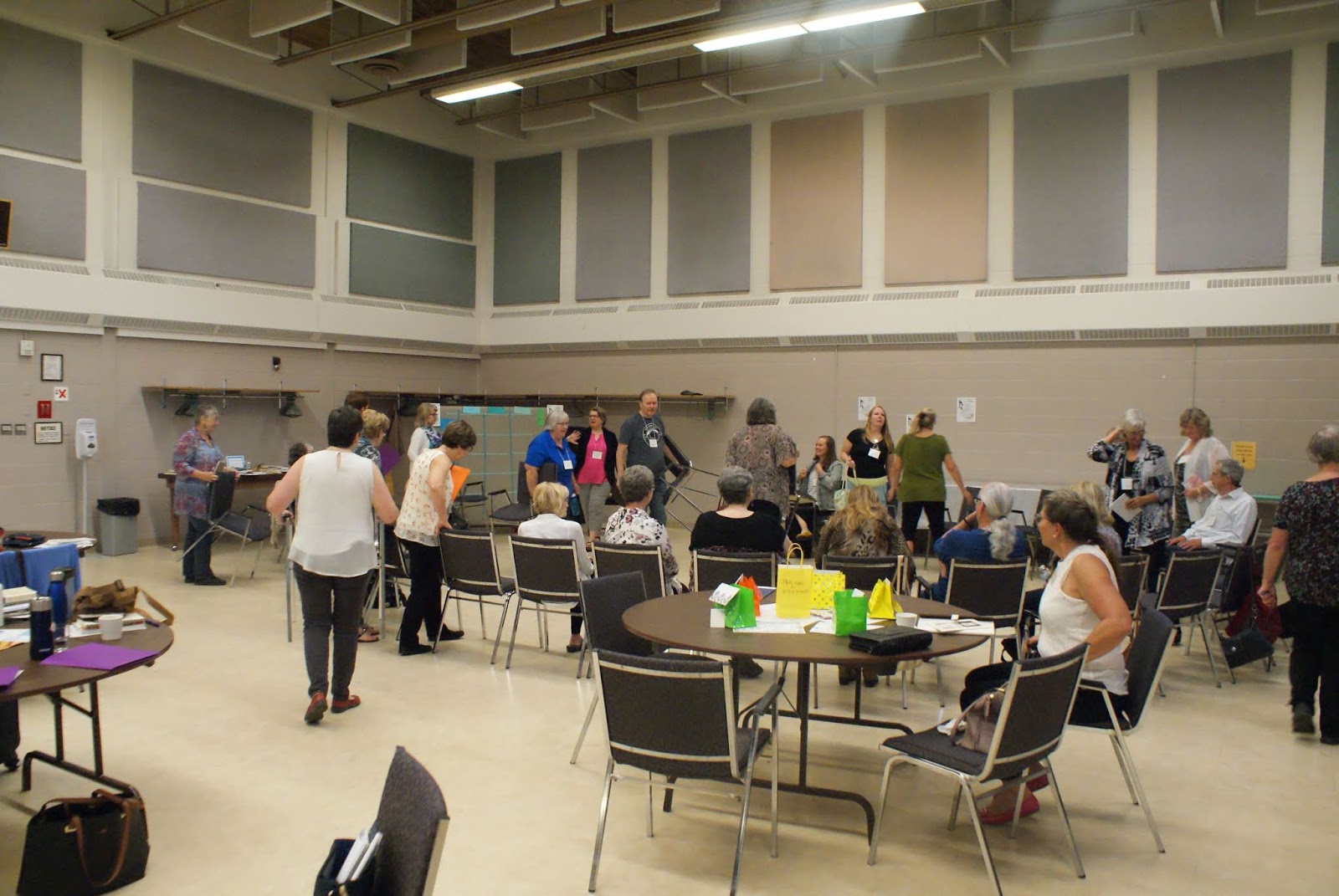
When I first checked our InScribe website to view the offerings at this year’s Fall Conference, I was disappointed that there were no formal workshops on offer. I read the explanation provided about the Open Concept Conference model with some trepidation. It wasn’t clear to me how this was going to work, so I did a bit of research on this type of meeting. Being an introvert, I wasn’t sure if this participant-driven format would suit me at all. I pondered it for quite a while before I finally decided to go ahead and register. Even though the format didn’t appeal to me, I had to admit to myself that this interactive Open Concept model might actually be good for me. You know . . . like that medicine that tastes awful but cures what ails you?

The explanation given for the Open Concept model included the invitation to come with an idea for a topic that we wanted to learn more about. Since I was planning to create my own website, I was eager for any information that I could glean from other attendees on this process. So, I decided to suggest this topic for one of the sessions. I had no idea whether many would be interested in this topic, but I was pleasantly surprised to see the assigned room fill up quickly with those who were eager to talk and learn about website building. There were several who already had their own websites, and it was enlightening to hear their experiences with the different website platform providers, such as WordPress, Wix, and Squarespace. There were also a few, like me, who were just getting ready to set up their own website and were looking for advice on the pros and cons of the various platforms, how easy they were to use, and what we should be thinking about including on our websites. I learned that two of the most important things to include are a newsletter and an email list for networking and marketing purposes.


The Open Concept model is governed by four “laws.” The first is the “Law of Two Feet.” It states that you are responsible for your own learning, which means that you are free to get up and leave a session at any time if you find it’s not right for you and join another. Someone suggested the analogy of “bees” and “butterflies” to explain how this works in practice. Some of us are “bees” who linger around gathering refreshing nectar, while others are “butterflies” who tend to flit from place to place. I am one of the bees, so I was happy to stick around and collect as much as I could from each session. I enjoyed all the sessions that I attended: Social Media, Medium, Marketing (Online & In-Person), Publishing with IngramSpark, and Christian Romance.


A highlight of the Conference for me was our guest speaker, Sigmund Brouwer, who writes novels for both children and adults. He describes himself as primarily a storyteller and this soon became obvious, as he is an extremely engaging and humorous speaker. I especially enjoyed his powerful presentation on and reading from his book, Thief of Glory, based on his father’s experiences as a young boy in a Japanese internment camp during World War II

So, my initial hunch proved correct. This Open Concept Conference format that initially left a bad taste in my mouth turned out to be good medicine for me. Along with refreshing the relationships I’ve developed with other InScribers over the years, this format encouraged me to come out of my shell much more than I would have during a traditional conference. Now that I no longer feel apprehensive about attending an Open Concept Conference, I’m hoping InScribe uses this format again in the future.