Showing posts with label audience. Show all posts

May 16, 2023

E is for Everyone by Lorilee Guenter


Reading a Story

I write because it is one way I work out my thoughts. I draw to relax. These are just two ways of interacting with the world around us. Everyone has ways they prefer to experience this life we have been given. We have also been given a community we can share our experiences with.

Sometimes when I think of the phrase, 'everyone has a story' I cringe. It is true we have a story, however sometimes that statement is used to suggest we should all share in the same way. Everyone has a story but everyone also has a unique voice. Our experiences, our gifts, our talents and our preferences all impact how and where we share. A poet has a different audience than an essayist. I could continue to list all the variety we have in our community as writers but I would miss some. 

As writers we have opportunity to share our stories with people near and far. Some of us have been given an audience that is geographically diverse. Other have an audience close to home. Whatever place we have to share our words, we have an obligation to follow the Holy Spirit's leading and share. When we hold back, when we mute our voice, there is a gap in the greater story of God's redemption.

This week I was reading the recorded story of Lazarus in John 12. I noticed that following his being raised from the dead, people came to Bethany not only to see Jesus but also to see if what they heard about Lazarus was true. Verse 11 stood out to me "on account of him [Lazarus] many of the Jews were going away and believing in Jesus." Lazarus' story made a difference. We may never see or hear the impact that our writing and our lived stories impact people. I am confident that when we are obedient to the promptings of the Holy Spirit, they make a difference in some way. 

On account of our time with Jesus, we have something to share. Everyone who believes has a unique place in God's story. 

February 26, 2018

The Reasons I Write - Marnie Pohlmann

A Mom struggles to overcome harmful thoughts that were hardwired into her brain during childhood trauma.

First responders search for ways to protect themselves from the cumulative stress of carrying the pain and pictures of those they have served. 
A young woman is anxious about an upcoming surgery that may remove a breast as the doctors cut out cancer.

An immigrant family who knows they are now safe cannot erase from their minds the thoughts and nightmares of the horror they have experienced.

A young woman betrayed, beaten, trafficked to be owned by others. Trapped.

A First Nations woman is stuck in the belief the past defines her and determines her present and future, unable to see any choices.

A young man grieves his life choices, his failures, and contemplates a choice to stop the pain coming from the consequences.

A teenager is confused about her identity, yet she trusts no one with her secret because they would not understand.

A believer in Christ becomes depressed; her faith seems to only condemn not comfort her in the darkness.

Each of these individuals is who I imagine being my audience, the "world" my writing could possibly influence. I am burdened with the pain and darkness these people are experiencing because I relate to them. I have been in these situations, believed these thoughts, considered these actions. Yet I have also found hope and peace through Jesus Christ who provides life amid the darkness. I still struggle but I have experienced victory in these areas before and I know I will again. Not that "I" can, but that God will walk me through the darkness and teach me new ways of thinking, feeling, and acting.

Does my writing or speaking change the world? Honestly, I rarely get feedback on what I share except family and friends who love me and other writers who encourage me. So, I don't know. I don't hear of or see my words changing any of the people in my imaginary audience. Perhaps, although I occasionally share the words, I write only to solidify in my own ears, eyes, brain, and heart the truth of God’s redemption.

While I would like to think I can change the world through writing blogs, poetry, lyrics, magazine articles, fiction, or memoirs or by speaking my understanding of God's Word, changing others may not be the result or the purpose. I am called to write, but how that writing is used is out of my hands. That is God's department. I believe He uses anything He wants to further His Kingdom, whether a silver chalice or a chamber pot. So yes, He can use even me, even my writing, though the ink may flow in words that mention nothing of God.

Psalm 45:1 says in the Message paraphrase,
"My heart bursts its banks,
spilling beauty and goodness.
I pour it out in a poem to the king,
shaping the river into words."

(I shared a couple years ago on my blog, Phosphorescent, an essay delving into what this verse shows to a Christian writer, called "Waterfall.")

Walking with God, whether in darkness or joy, my heart bursts when I contemplate His grace to me. I then cannot help but write. My true audience is God. His love is amazing and we as Christians who write cannot express that at all adequately. Yet we must try. Yesterday at church we sang "The Love of God," a hymn expressing that truth.

Writers who are Christian, whether or not we know we are changing the world with our writing, have three reasons to continue.
To change the lives of others.
To change the life of ourselves.
To bring joy to God.

God’s Word changes hearts. Our words - written, spoken, sung, or acted out, - may be used by God to change the world. Therefore, I write.


*photos CCO license compliments of Pixabay.com


God is present. God is at work. Marnie writes.
Phosphorescent

July 24, 2014

Writing to a Different Audience by Lynn Dove


This month’s focus was writing in a genre, voice/style or for a particular audience that I would not normally write in or to. Still I couldn’t help but giggle when I entitled this blog post “Writing for a Different Audience”. It just begs quotation marks around “different”, does it not?

As I thought about it, the comedic side of me immediately surfaced and I thought about what “different” audiences I should write about or to. So here goes:

Writing to my dog would require a bare bone plot line and may be a little rough (ruff) around the edges.

Writing to a cat would require a scratch-pad handy to jot down my thoughts and ideas, but in the end I would only be able to scratch the surface…it would never be absolutely perfect (purrfect) or to the cat’s liking or licking as the case may be.

Writing about a tree would leaf me breathless, especially if I made sure a few shady characters were thrown in for dramatic relief that wood leave the reading audience rooted to their seats.

Writing about a vacuum cleaner would require catchy pick-up lines but in the end the plotline would likely suck.

Writing about a cellphone in the context of a mystery novel would require indecipherable code (LOL), a limit of text, characters, and horrific grammar. It wd B a Bst sell R 4 shur!

Lastly, writing while on vacation may not have been my best idea, but it definitely has been fun!


Feeling punny? Add one of your own for all the writing pundits out there...hahahaha!


August 29, 2012

5 Reasons Writers Should Use Twitter - Ruth L. Snyder

Several years ago I was encouraged to open a Twitter account. I knew I didn't have time to blog regularly and I decided to use Twitter as my "mini" blog. With a bit of trial and error, I learned how to use Twitter. Today I consider Twitter to be part of my professional development. Here are five reasons I think writers should use Twitter.

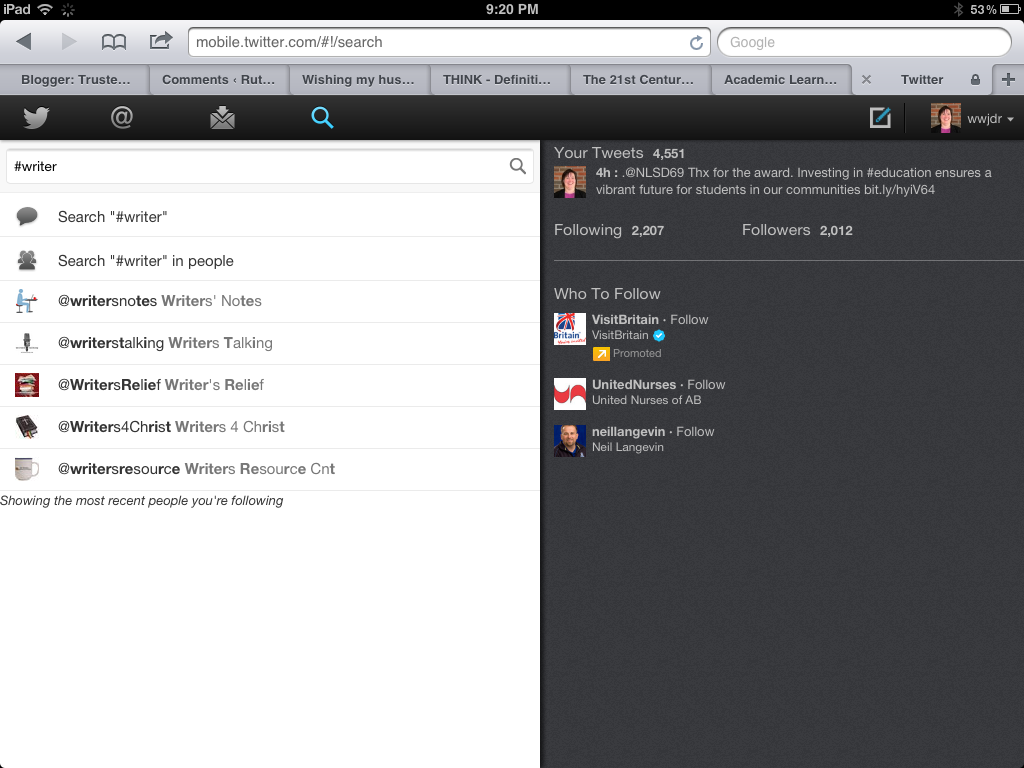
1. Use Twitter to expand your network - Twitter is an easy way to "meet" people with like interests. Find people who are writers by typing #writer into the search bar at the top. You can then read tweets of people who use the hashtag (#) "writer" and decide who you would like to follow. Usually if you follow someone, they will follow you back. People also tend to follow those who share helpful content, so share links to information that you as a writer find interesting. Twitter is all about building "relationships". This takes time. I've been on Twitter for over three years and have about 2,000 people who follow me.

2. Use Twitter to find information and resources - I find that searching on Twitter often yields more useful results than searching on Google or another search engine. Most people with Twitter accounts use hashtags like #amwriting to provide an easy way to "index" or file their tweets and to find tweets on the same subject. Here's a list of helpful hashtags for writers. You may also wish to research specific topics you are writing about. You can type anything into the search feature. If you type something with a hashtag, all the tweets which contain that particular hashtag will come up. All tweets that have a specific word or phrase will come up if you enter it without a hashtag.

3. Use Twitter to share information - If you find a link that is useful to you as a writer, share it with other writers. Perhaps you were inspired by a famous #quote. Others will probably enjoy it too. If someone else tweets something you find helpful, use the "retweet" function to share the information.

4. Use Twitter to build excitement about your next book - The ideas are as limited as your imagination. You can share short snippets from the plot. (Remember that you are only allowed to share 144 characters at a time.) Perhaps you want to introduce readers to your main character and give them some backstory. Tweet when you've finished the next chapter.

5. Use Twitter to build your platform - Michael Hyatt shares why you can't succeed without a platform. If you don't care about having people read what you write, building a platform is not important. However, most of us want to share what we write. You will note that Twitter is only ONE way to build your platform, along with blogging, Facebook, newsletters, and podcasts.

What have your experiences with Twitter been? Have you found it helpful as a writer? I look forward to hearing from you.

Ruth L. Snyder
www.trusteesnyder.blogspot.com (Education information)
www.ruthlsnyder.com (Ruth's writing and family life) 
www.earlyyearssuccess.com (Information for caregivers of children ages 0-5)

Follow Ruth on Twitter:www.twitter.com/@wwjdr

June 15, 2012

Who Are You Writing For Anyway? Tracy Krauss

We are told to write with our audience in mind. The more specific we can be in our our minds about who that audience is, the better our chances of reaching them - or so we're told. In today's publishing world where marketing is KING, this makes sense.

But what about that more important audience. The audience of ONE. (And I don't mean 'oneself'.) We are admonished in the Word to do all things for the glory of God... to do everything knowing that HE is the ultimate critic.

It's a sobering thought, whether you write fiction, devotionals, poetry, or articles for the local paper. It's a question I ask myself every time I re-read something I've written. Will God be pleased with my efforts? In the end, this is the only question that matters. He's the real King, after all.

May 29, 2012

5 Ways My Writing Has Benefited From My Piano Lesson Experiences - Ruth L. Snyder

As a child, I dreamed of taking piano lessons for several years. However, I didn't have access to either a piano or a teacher. When I was nine, my three siblings and I traveled five hundred miles away from our missionary parents to attend school in Zimbabwe. I can still hear the cadence of wheels clacking across train tracks as we sped further and further from our home in Botswana. Although it was incredibly difficult for me to be so far away from my parents, one of the benefits was the opportunity to take piano lessons. Because I was a bit older and  was motivated to practice diligently, my piano playing progressed fairly quickly. A year later when my family returned to Canada I was placed in grade 2 piano. Since then I have experienced many more lessons, practice sessions, recitals, and exams. Today I enjoy sharing my knowledge and abilities with piano students of my own.

As I think about writing, there are several benefits I gained from those many years of piano lessons:

1. Focus.
It takes focus to learn how to read music, to listen so that you bring out a melody while also playing harmonies expressively, to create tones that are beautiful. Writing also takes a lot of focus. This is especially true when you have young children. Having the ability to focus makes it possible for me to write at different times of the day, in many environments, and to be more productive in my writing.

2. Discipline.
We all have a multitude of activities competing for our attention. The discipline of daily piano practice taught me how to stick with something, no matter what the distractions were. I learned that discipline paid dividends - the ability to play new pieces, make progress, and achieve an objective. Writing also requires discipline. If I only wrote when I felt inspired or motivated, I wouldn't get much writing done. Although I certainly enjoy the days when the words pour out onto the page, the discipline of writing regularly makes it possible to set goals and achieve them. (If you struggle in this area, sign up as a contributor to this blog!)


3. Effective Practice.
I often warn my students, "Be careful how you practice, because practice makes permanent." Sight reading is one thing, but learning and polishing a piece of music is entirely different. It is tempting to start at the beginning of a piece and play it all the way through, ignoring the mistakes. A skilled pianist tackles the difficult sections of music, is diligent to use consistent fingering, and always works at making her next performance better than the last. Writing a first draft could be compared to sight reading. The main idea of a piece comes across. However, to create something of worth and beauty, further refinement is needed. Effectively practicing piano has prepared me for the rigors of editing. Skillfully using language makes it possible to make writing come alive.

4. Appreciating Variety.
My training under the Royal Conservatory of Music exposed me to a vast array of musical eras and composers. Although I enjoyed some more than others, I came to understand the skill and beauty of a wide variety of music. These lessons have helped me to be less judgmental and more appreciative. In my writing, I have also benefited from exposure to a variety of writing and writers. Although I am more skilled in using some styles, making myself aware of a wider variety serves to improve the palette of tools I have available to express ideas to readers. I am also able to appreciate styles of writing which vary widely from mine.

5. Performance.
I do not consider myself a performer. In fact, musical performances often reduce me to a bundle of nerves. Learning music for my own enjoyment is fine. However, I have come to realize that God has gifted me so that I can encourage and inspire others. One idea that has helped me immensely in performance situations is to focus entirely on the music so that I am not as conscious of others who are listening. When I focus on the enjoyment of playing the piano and making the music come alive, nerves tend to take a back seat. Writing for my own enjoyment is fine. However, I have to be willing to be vulnerable to share my writing with others. No one enjoys receiving rejection letters. Most writers I know get discouraged from time to time. However, if we focus on producing the very best writing we possibly can, eventually we will discover the audience God has appointed for us.

Have you found parallels between other skills and writing? I look forward to hearing about them.

Ruth L. Snyder

Check out Ruth's blogs: www.trusteesnyder.blogspot.com (Education information) www.ruthlsnyder.com (Ruth's writing and family life) and www.earlyyearssuccess.com (Information for caregivers of children ages 0-5)

Follow Ruth on Twitter: www.twitter.com/@wwjdr