February 10, 2022

Jesus and the Flight Attendant - Guest Post by Jack Popjes


“Hey, kids! Share your toys!”

“Save some cookies for your brother!”


Parents need to improve their children’s behaviour frequently. Why? Because babies are born selfish, the most selfish people on the planet. It does not come naturally to a child to share with others. It takes years of consistent example by self-less parents and constant reminding to teach children to look not just to their own needs but to the needs of others.


The Flight Attendant Story

I sometimes wonder what little kids think when they hear a flight attendant tell their mommy to be selfish. You’ve listened to them on every flight. After the seat belt demonstration come the instructions for the oxygen mask. “If you are travelling with a small child, first put on your own mask, then put the mask on your child.”


How selfish! How unloving! What a terrible example to a little kid!


No, not really! When mommy makes sure she stays conscious, she is acting in practical love to her poor, gasping little daughter beside her. It’s a fundamental principle of life. We must look after our own basic needs first before we can meet the needs of others.


Jesus Story

Jesus, like the flight attendant, taught the same thing. How do we love our neighbour? First, love yourself, then love your neighbour as you love yourself. That was the preface to Jesus’ famous story of the Good Samaritan who stopped to help the naked, bleeding victim of a vicious mugging. The hero in this story not only felt sorry for the victim, but he also had wine and oil to cleanse the wounds, and he had cloth for bandages. He had enough clothing for the victim to wear and a donkey for him to ride on. And when they arrived at the inn, he had money to pay the innkeeper for food and rent. (Luke 10:25-37)


Before starting his journey, the Good Samaritan first looked after his own needs for the trip. Since he had supplied himself to meet his own needs, he could now share some of his supplies and clothing to meet the naked bleeding, robbery victim’s needs. By loving himself first, he could give what he had as an act of love to someone else.


Your Story and Ours

The Bible teaches that our human instinct to love ourselves and care for our own needs is normal and natural. Satan, of course, wants to pervert this natural instinct, and he tempts us to focus only on meeting our own needs. That is why we need to follow the Bible’s teaching to “look also on the needs of others.”


Our world abounds in opportunities to show love to others—a pot of freshly made soup for some sick friend, a bag of winter clothes to distribute among the indigent, donations to the Food Bank. And missionaries keep telling us about people’s enormous physical and spiritual needs in third-world countries.


God is pleased when we reject Satan’s temptation to be selfish, but we must not be so focused on the needs of others that we neglect our own physical, mental, and spiritual health. We must first take care to have a strong relationship with God. Then we must take care of our family members and our work responsibilities. If we don’t care for our own spiritual, mental, physical, family, and financial needs, how can we possibly make an impact for good on the needs of people around us? We would be like a mommy who disobeys the flight attendant’s orders and tries to help her little girl first, but both end up slumped unconscious in their seats.


Jo and I were tempted at times to focus all our energies on meeting the numerous needs of the Canela people with whom we worked in our younger years. Sometimes we neglected to meet our own needs for rest and recreation. Sometimes we even failed to meet each other’s needs. It might sound very “dedicated” to focus so intensely on meeting the needs of others, but, as Jesus taught, we can’t love others properly unless we love ourselves first.


Jesus and the Flight Attendant first appeared on Jack's INsights & OUTbursts.

Copyright © 2022 The Wordman, All rights reserved.
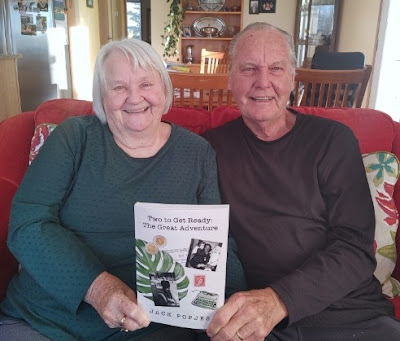


Born in the Netherlands in 1938, Jack immigrated to Alberta, Canada in 1950 as the oldest of a family of five children. He was the first of his family to be converted. He graduated from Berean Bible College where he majored in English and biblical exegesis. Jack and Jo met at this college and were married in 1962.

They pastored a Baptist church in Alberta for three years before joining Wycliffe in 1966, and moving to Brazil with three pre-school daughters. They began linguistics, translation and literacy work with the Canela people of Brazil in 1968.

February 08, 2022

What is That in Your Hand? - Guest Post by Ruth Keighley


For years I struggled to believe and accept that God gave me the gift of writing. When I first started writing I had no faith in my ability to write anything that someone else would be interested in reading. I joined a Christian writer’s group but it took a long time before I was willing to share anything I had written. I was embarrassed by my lack of knowledge. I was hurt when someone would critique my work, which I translated as criticism.  

Years ago, I wrote a long poem telling my father-in-law’s story. It was 50 stanzas long. I sent it to my aunt for a critique. She sent it back with a few suggestions such as omitting a couple verses that were redundant. I was so hurt that I threw the document into a drawer with the intention of never reading it again. A couple years later I found it and reread it. I was so amazed at how my perspective and attitude had changed. Yes, my aunt was correct. Those verses were unnecessary and leaving them out and following some other suggestions made the story so much better. 

I decided then and there that I could be a writer. That is what God had called me to do. Since that time, I have published two books, am ready to publish a third, and am working on a fourth. A couple more are waiting in the wings. 

When God called Moses to do a mighty work for him, he questioned God, “What if they do not believe me or listen to me?” God asked him, “What is that in your hand?” Moses answered, “A staff.” God promised him that he would use that staff to show his people his power. Exodus 4:2 

God asks us, “What is that in your hand?” We answer, “A pen.” God has given each of us the mysterious gift of writing. We can’t fully comprehend the power we wield when we put pen to paper. We will use that pen to bring words of pleasure and light, words of instruction and warning, words of encouragement and blessing, and words of life and healing. Or we can use our pen to pass on words of heaviness, destruction, deceit and betrayal. 

Jodi Picoult, said, “Words are like eggs dropped from great heights; you can no more call them back than ignore the mess they leave when they fall.” It is essential that we choose our words wisely. They must be significant and accurate. Words define reality, whether positive or negative. 

In Revelations 1, we are told that John saw visions of things to come. God told him to write on a scroll everything he saw. Verse 3 gives us the outcome for the readers. “Blessed are the ones who read the words of this prophecy.” We have no indication how many or who will read our words but God has promised to bless others when we obey him and use the tool he has put in our hand. And we, too, will be blessed.

Putting our words on paper carries with it an awesome responsibility but we needn’t fear it. The genre doesn’t matter. We all have our own preferences and genres in which we write the best. 

I encourage you to face that empty page and pick up the pen that God has put in your hand and do what you do well. Write to be read.

Ruth Keighley is a wife, mother, grandmother and great grandmother living in Warman, SK. She loves writing, reading, jigsaw puzzles, and hand embroidery. She has authored one book, Healing for an Unquiet Mind, and co-authored one book, Making the Crooked Places Straight.


February 07, 2022

A Bumpy Path of Love - Guest Post by Christine Smith


 Love is not proud… it is not easily angered, it keeps no record of wrongs.  1 Cor. 13:4-5

This new year started with God inviting me into a path of love that I had not been looking for.  It was a bumpy road that God thought I should travel on three times, to make sure I got the lesson. The name of this path is apology. 

Naming sin and apologizing is not a new concept for me.  Growing up, I went to a church where every Sunday we confessed our sins to God and heard that He was faithful to forgive us.  As a parent and elementary school teacher, apologies are a regular part of life. At home, in the classroom, and on the playground, I teach kids to say “I am sorry for…” and then to say “I forgive you”.  I am also blessed to work in a school where apology is a regular way of being among the staff.  When wrong choices are made, I have witnessed, and also given, apologies that brought healing and health to our community. 

I would love to tell you that I read a remarkable book on apologizing, such as “The Five Languages of Apology,” but I did not. My recent lessons in apologizing came from the school of real-life relationships.  My teachers were three family members very close to me, two in my own house and another whom I have been related to my whole life. Each situation with these loved ones involved an intense discussion, okay, argument, that left both participants very angry. The anger stemmed from a cyclical pattern of discussion going wrong, with both parties to blame.  The trigger might have been different than other times but the pattern of thoughts were familiar.  Each party made mistakes they had made before. Because of this, what God led me to do next was a revitalizing new trail.

In the past I have viewed that apology after conflict should go something like this: I say I am sorry for my mistake, then the other person says sorry for their error.  Both say I forgive you and we try again. What happened recently was very different for me because I felt God leading me to just say sorry for my part and not be concerned with the other person’s role in the problem. I learned that an apology that is well received does not include listing the other person’s faults.  In Matthew 7, Jesus stated that we should first take the plank out of our own eye, and then we will see clearly to remove the speck from our brother’s eye. I believe a humble apology that focuses on one’s own mistakes is one way we can do this. The faults of the other are still there and should be addressed at a future time, but not while apologizing. 

Owning our mistakes and asking for forgiveness when others have hurt us is difficult.  It is humbling and it can be confusing. But it is love, because love is not proud. I found that much prayer, reflection, and letting God’s Word speak truth into my heart helped me know which parts of the conflict were my sin. I also found that writing out my apology, even reworking the words over and over to ensure I removed the log in my eye, enabled me to give a sincere apology. Two of my apologies last month were written out ahead of time and read by the hurt family member. These went better than the other one with less preparation because in that case, I unfortunately once again started to list the other person’s sin rather than just my own. Bumpy road indeed. 

Proverbs 15:1 says “A soft answer turns away wrath, but a harsh word stirs up anger”. 

I pray as you walk through challenging moments in your relationships you are able to take time to step back to look at your own mistakes, possibly apologize, and find new habits and paths of healing as you move forward in God’s restoring love.


Christine loves words: having stimulating conversations with people, reading a variety of books, and most recently, the words she writes.  She is a teacher who is just beginning to write for audiences other than herself in her journal or her students’ parents.  Christine lives in Langley, B.C. and enjoys coffee, being outside, and making memories with her husband and four kids.


February 06, 2022

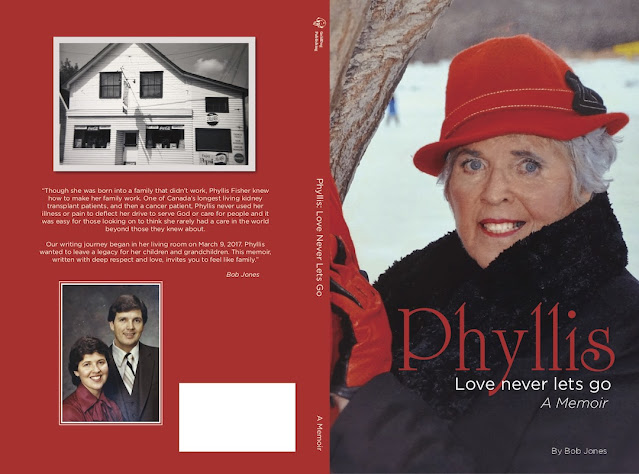
Love Never Lets Go by Bob Jones


“Your problem is how you are going to spend this one and precious life you have been issued. Whether you're going to spend it trying to look good and creating the illusion that you have power over circumstances, or whether you are going to taste it, enjoy it and find out the truth about who you are.”
― Anne Lamott


“Bob, will you help me write my story?” There was only one possible reply. “Yes” was out of my mouth before I fully thought through the significance of the commitment. Phyllis Fisher thought my yes was a gift to her but the privilege was all mine. Writers love what we do and sometimes what we do is love in writing.


FULL CIRCLE

I met Phyllis when her husband Bruce, tied the knot for my wife, Jocelyn, and I in 1979. Eleven years later, Bruce invited me to join his pastoral staff at Central Tabernacle in Edmonton, Alberta.


Only four years passed before our lives went full circle. Bruce’s health was failing, and he could not sustain his pastoral responsibilities. The congregation handed me the baton as their pastor positioning me as Phyllis and Bruce’s pastor. The significance of this rare relationship was never lost on Jocelyn and I. Phyllis was Jocelyn’s biggest cheerleader. “She inspired me to believe I could be the pastor’s wife of a significant kingdom church.”


TRANSPLANT

In 2015, Phyllis was diagnosed with cancer. Intense treatments were not enough to prevent the end of her life from speeding towards her in 2018. The prognosis inspired her to create a legacy piece for her grandchildren and invited me to help her write it. The afternoons we spent together recording her memories were sacred moments. She invested precious hours of her remaining life into insuring her grandchildren would have a written legacy of her convictions and values.


Phyllis was one of the longest surviving kidney transplant patients in Canada. In fact, she was a double transplant patient. Her desire was for people to be assured that organ transplants work. She conferred with many patients who were afraid to have a transplant and when she told them how long she had her transplant they’d respond, "You have been how long?!" When she reached thirty years as a transplant patient, her story was about encouraging other people, not about her.


She introduced me to the woman who donated one of her kidneys when Phyllis’ first transplant failed. We met to capture the donor's story for the book. I listened in on their lively conversation in the Fisher living room, unaware that less than two months later Phyllis would be in heaven. Anyone who knew Phyllis was always surprised when they learned about her beginnings. She lived a love that was beyond her natural experience.


ABANDONED BUT NOT FORSAKEN

Phyllis was a pre-schooler when her father abandoned the family. Her mother was unable to care for her, so Phyllis lived with other families during her formative years. After high school she was applied for Bible College and was pleasantly surprised that they would accept "a girl like her." While at college she met the love of her life and she faced an early end to her life. Kidney failure threatened her future. Dialysis in the 60's was primitive and painful. Through it all she shared her faith with nurses and doctors and was sustained by a calm assurance that God's love would never let go. In the same year Bruce and Phyllis wed, she received a new kidney. 


Though Phyllis was born into a family that didn’t work, she knew how to make her family work. Her fragile health prohibited her from carrying a baby, so Bruce and Phyllis adopted two children. Phyllis never used her illness or pain to deflect her drive to care for people and it was easy for those looking on to think she never had a care in the world beyond those they knew about. Phyllis fulfilled her dream of becoming credentialed as an ordained minister and a chaplain. When Bruce went on permanent disability, Phyllis became the breadwinner, employed by the Ponoka Hospital and Care Centre. 


Our writing journey began in her living room on March 9, 2017. We met for a second interview on March 17th - Saint Patrick’s Day - a fitting time as Phyllis was proud of her Irish heritage. There was no blarney in her answer when I asked how she was feeling. “I’m at a five out of ten on a pain scale. Three would be a threshold where some attention needs to be paid to my pain level. But that’s OK.”


We met again over the next five weeks and fully expected to meet with her in May. Sadly, she needed tertiary care. Our conversations came to an end. Within days she passed. I did my best to fill in the gaps and published her memoir, Love Never Let’s Go a few weeks after her death. 


Phyllis left a resounding testimony of God's love and care. She lived her too short life to the full. The Fisher family and their friends expressed appreciation for creating a memoir of Phyllis' life, but I was the one with gratitude for being entrusted with this sacred responsibility. As a writer there is no greater trust than to be invited in to chronicle a love story. Truly, love never lets go.


I write to grow hope, inspire people to be real, forge an authentic faith in Jesus, and discover their life purpose.

Please follow my writing at REVwords.com

I would love to hear from you.