Showing posts with label book review. Show all posts

May 27, 2025

BOOK DAY: Living Liminal (Linda Hoye); Review by Lorrie Orr


Book Day

It's where we highlight books that InScribe members have read and recommend—based on our blog themes of Faith and Writing. This month's selection is written by one of our own InScribe members, Linda Hoye. 


TITLE: Living Liminal: A Slice of Pandemic Life


AUTHOR: Linda Hoye

PUBLISHER: Benson Books, Moose Jaw, Saskatchewan, 2023

"Pandemic day n. Who knows anymore? Day by day. Hour by hour. Focus on the better things. The timeless and unchangeable things. Let the rest fall away. Now is the time to grasp the truth that we as human beings are not as in control of things as we would like to believe. It is the time to lament and to trust and to turn our attention toward home and toward God. Maybe the one true thing we can do today is to turn things over."


Each of us experienced the Coronavirus pandemic that began in March 2020 differently. In Living Liminal, Linda Hoye shares her thoughts written during the days of 2020 and 2021, bits of blog and social media posts, poetry, and journal entries, along with provincial health orders and statements. The book is a chronicle of one woman's story during the uncertainty and turbulence of pandemic times, compounded by the devastating forest fires and floods in British Columbia in 2020 and 2021. 

Hoye's experience was home-centered, as it was for many in the world. She describes her habit of rising early to read, write, and drink tea while cuddled with a blanket and her dog. As a person who enjoyed solitude, the experience of enforced time at home with her husband and occasionally a granddaughter, had a different, unsettling feeling about it. Hoye shares her struggles with sliding into depression, with being overwhelmed by circumstances, and most of all, about her trust in God to bring her through this time. She writes of changing seasons, of details of time-stopping encounters with nature, and of the comfort of a lighted candle in the darkness of winter. Comfort is found in short conversations with friends, in books, and hot cups of coffee. 

I very much enjoyed reading Hoye's perspective on the pandemic. My own experience was much different. As a teacher, life became busier. My husband, a health-care executive, worked constantly. I found myself envying those who had time to bake sourdough, dabble in watercolour painting, and who wrestled to fill their days. Living Liminal gives me another look at how others navigated these days, weeks, and months, and has given me empathy for the different struggles everyone endured. 

Hoye ponders "I wonder if, as life hints at returning to something more "normal", we will forget lessons learned in the quiet? Will we take deep pockets of inactivity with us into whatever comes next? Have we come to appreciate the wisdom of not always doing? Are we comfortable with less? Or frantic for more?" We could ask ourselves these questions today as new challenges face the world. What kind of life do we want to live? 

Find more of Linda's writing at her Substack account. 


Lorrie Orr writes from her home on Vancouver Island, posting on her blog, and Facebook.


November 29, 2024

Reclaiming Quiet, A Book Recommendation by Brenda Leyland


Title: Reclaiming Quiet, Cultivating a Life of Holy Attention
Author: Sarah Clarkson
Publisher: BakerBooks, Grand Rapids, Michigan, Nov 2024
Genre: Christian Living/Spiritual Growth
Available In: Paperback, Audiobook, Kindle (Amazon.ca)

"I wanted God to give me quiet and bring me rest, but all the habits of my daily existence were shaping a life of exhaustion, of inward disquiet and outward unease. I don't think I'm alone in this." Sarah Clarkson

Have you ever thought longingly of those words in Psalm 23 where the Good Shepherd says he will make our souls to lie down in green pastures and lead us beside still waters? And, have you ever longingly wondered if this is still possible in our news-harried, social-media'd culture where it can feel nigh to impossible to cultivate the quiet that our souls - and bodies - long for?

In response to my own questions, yes, I do sometimes wonder, even now in my own more relaxed retirement pace. The whole world feels wound up like a top; so much feels chaotic, frantic, and out of order. Which is why I was jubilant to read Sarah Clarkson's long awaited book Reclaiming Quiet, Cultivating a Life of Holy Attention. And I wasn't disappointed. She thoughtfully invites her readers to join her in searching for a way that, indeed, makes room for quietness in the midst of the fray. And she has learned not to scorn the tiniest of moments in which the quietness will show up even in a busy, noisy life. Sarah presents her discoveries and wild musings with honesty, and I admire her courage to grapple them into words the world can read. Her gentle writing draws me in so I, along with her, can feel the Divine presence, his benediction, and his tender love in that quiet space. Sarah's use of language is beautiful. Her thoughts are wise. A heart longing for quiet can safely sink into these pages that are filled with hope and peace.

"What is small?
Children are small.
Seeds are small.
Moments are small.
Yet of these the whole world is composed."
Sarah Clarkson 

I admit reading Reclaiming Quiet at a fair pace the first time through - I like to know the lay of the land, as it were. But I'm currently rereading it at a snail's pace, giving myself the gift to deep-breathe those lines that fall as liquid gold from the author's pen. In many ways Sarah reminds me of myself in my younger years, not that our lives are similar - she studied in Oxford which would have been a far off dream for me. But her inner life search for truth, beauty, and Jesus resonates deeply with me.

Sarah assures us that in our search for quietness, "Our hobbit life (is) not a denial of disorder and pain or a refusal to engage those things where we could. Rather it (is) a refusal to allow those forces to define our story or that of the world." Oh yes, to that last sentence.

With the Christmas season nearly upon us, Reclaiming Quiet would make a lovely gift for anyone, including yourself, who finds themselves in that restless, distracted place. Find a quiet spot during Advent or after the holidays, sit with your favourite beverage, and anticipate a soul nourishing read.

Sarah Clarkson is undoubtedly my favourite inspirational author. I follow her on social media and also have been inspired by her other books, including Book Girl (on the reading life) and This Beautiful Truth (about her dark struggles with mental illness and depression). Sarah is an accomplished author, wife to her vicar husband, and busy mom of four young children. She and her family live in a large Victorian vicarage in Oxford, UK. Sarah can be found on Facebook, Instagram, X, Patreon, and Substack.


Inspired by the beauty of God's world around her, Brenda loves working with words and shaping them into beautiful thoughts for good. Her sweet spot place for writing is on her blog It's A Beautiful Life, and she also enjoys being a Guest Blogger here. A longtime member of InScribe, she has been a contributor and columnist in FellowScript magazine and has contributed to two InScribe anthologies.

March 22, 2023

The Creative Call - Book Review, by Lorrie Orr


For more than a quarter of a century, Julia Cameron's The Artist's Way has been a classic for people seeking to give voice to their creative bent. It's a useful and life-changing book, but misses one important aspect - the acknowledgement of a personal and creative God who empowers his people with his Spirit. 

Julia Elsheimer, in The Creative Call, names the God of the universe and acknowledges him directly as the source of creativity, particularly for a Christian artist. Each chapter is anchored with Scripture verses, and readers are encouraged to memorize the verses, something Elsheimer calls "word play." 

In the chapter "Listening" Elsheimer writes "This perception that art is an expression of something moving through us rather than from us is not limited to Christian artists, but Christians are likely to identify the feeling as the Holy Spirit manifesting himself through them. As you write in your daybook, pray that God will reveal himself to you through the words you write." Listening to the Spirit's call and trusting him in living out this call is the focus of the book. 

Throughout the book there are exercises related to Listening, Awakening, Forgiving, Breathing In, Breathing Out, and other chapter titles. I went through the book several years ago, and after pulling it off the bookshelf, I think I'll go through the exercises again. 

Elsheimer writes "If we have been given artistic gifts, the shape of our lives need to include the use of those gifts. God's gifts are not accident: 'Every good and perfect gift is from above, coming down from the Father of the heavenly lights, who does not change like shifting shadows' (James 1:17)." 

The book ends with a collection of prayers from saints throughout the ages. I find them poignant and powerful as I thought about how people throughout time have the same longings and desires to connect with God. I have several written out and placed in my Bible for easy reference. Here is a portion of one written by Desiderius Erasmus (1466-1536). 

Holy Spirit...
I beseech thee, maintain thy gifts in me,
and increase the things daily,
which thou hast vouchsafed to bestow upon me,
that by thy governance the lusts of the flesh may die
      more and more in me
and the desire of heavenly life more quicken and increase.
Let me so pass through the misty desert of this world 
by thy light going before me...


Lorrie Orr writes from Vancouver Island where she enjoys boating and hiking with her husband. Gardening, sewing, reading, and spending time with her five grandchildren fill her days with happiness and contentment. There is also the writing that always occupies a corner of her brain.

January 27, 2023

Let's Talk Books (Rooms of Their Own) by Brenda Leyland


TITLE: Rooms of Their Own, Where Great Writers Write
AUTHOR: Alex Johnson
ILLUSTRATOR: James Oses
PUBLISHER: Frances Lincoln, London (UK), 2022
HARDCOVER: 192 pages, $29.99CAN Amazon.ca
KINDLE: $17.32CAN Amazon.ca
SUBJECT: author biography, creativity, work spaces
- - - - - - - - - - - - - - - - - - - - - - - - - - - - - - - - - - - 

"Any spot is good for daydreaming so long as
it is in an obscure corner and the horizon is vast."
Victor Hugo


I was immediately drawn to that enchanting illustration on the front cover of Rooms of Their Own, Where Great Writers Write. I wanted to be there—sitting at that desk with its familiar old typewriter in front of that lovely window.* With the click of a button, the book was added to my shopping cart.

In his collection of fifty well-known authors, Alex Johnson focuses on the writing spaces where these famous people worked. He researched details that pique our curiosity of the writers behind the books, transporting us 'to the heart of their writing rooms'. Bios at the backs of novels are usually so brief, there is no way to get a feel of the person who wrote them. Alex Johnson, with well chosen particulars, fills in the blanks for us.

I love these kinds of books. They give me a sense of connection to the individuals who wrote the works that inspire me. I love to envision what they place around themselves, what items spur them on, what they do to keep creativity flowing. Sometimes I'm inspired to try something in my own writing space. Maybe like doing what Michel de Montaigne did: writing his motivational quotes directly on the walls, well, he actually had his quotes on the ceiling above his head.

Margaret Atwood writes her novels wherever she happens to be - in a plane, at a café, lying on her bed. Maya Angelou often booked into a quiet hotel to write. D.H. Lawrence considered the outdoors amongst the trees his writing room. And E.B. White spun out his tales from his writing shed on Allen Cove, Maine, sharing his sea-facing spartan room with a mouse and a squirrel. So many others I wish I had time to tell you about, include authors like: Isabel Allende, W.H. Auden, Ray Bradbury, Stephen King, Hilary Mantel, Dylan Thomas, William Wordsworth, to name a few.

The engaging essays in this book are paired with some wonderful sketches done by illustrator James Oses. With his pencils and paints he gives us charming glimpses of the rooms and spaces where the authors worked. Below is one picture that caught my eye; I actually got to visit this writing room several years ago.  
 
 Vita Sackville-West's writing room 

My husband and I, during our trip to England, visited Sissinghurst Castle and Gardens where well known gardener and author Vita Sackville-West once lived. Her gardens were breathtaking, but the place that most intrigued me was her writing room in the tower overlooking the gardens. She'd climb the narrow stairwell to this room where she created a wonderful place in which to write her novels and garden books. Something about standing in that space made me feel alive, a little in awe, certainly inspired—as I saw her books on the shelf, her chosen pictures on the wall, and how her things were arranged for her comfort and use.

If I had a bucket list, it would include visits to other famous or not so famous work studios of creators I admire, people like Charlotte Brontë, Emily Dickinson, Beatrix Potter, and Mark Twain. And, yes, their writing rooms are included in this collection. In the meantime, I am savouring this book. And I happily recommend Rooms of Their Own to you. 

Alex Johnson, author of several other books, is also a journalist and blogger. He is married with three children and lives in Herfordshire, UK. You can read more about him HERE.

James Oses is a London based illustrator 'specialising in drawing and painting from life'. You can learn more about him HERE.

*Note: The illustration on the front cover (top) is Sylvia Plath's writing room at Court Green in North Tawton, Devon.


Inspired by the beauty of God's world around her, Brenda Leyland writes from her home in northerly Alberta, Canada. She loves writing on her blog It's A Beautiful Life and occasionally posts on Facebook, Twitter, and Instagram.


October 12, 2022

Book Review: The 4 Disciplines of Execution - by Sandi Somers


TITLE: The 4 Disciplines of Execution: Revised and Updated: Achieving Your Wildly Important Goals

AUTHORS: Chris McChesney, Sean Covey, and Jim Huling 

PUBLISHER: New York: Simon & Schuster

PUBLICATION OF 2nd Edition: 2021

COST: $35.50;  Paperback: $25.73;  Kindle: $13.99 (current prices on Amazon.ca)

SUBJECTS: Goal setting in personnel management; Goal (Psychology); Organization.


~ ~ ~

 At the heart of every vision, every aspiration is a crisis…Look deep into the heart of your crisis. Figure out what problem needs solving the most, or nothing else matters.

Beverly Walker


Making explicit goals and expectations is vital to success. The authors of The 4 Disciplines of Execution have proven that following through on your most important priorities will require a significant change in your behaviour and will produce breakthrough results.

 I began using The 4 Disciplines as I’m now focusing on finishing my book of devotionals, revising drafts to the best of my ability.  I’ll give you my examples to help clarify the principles and strategies.

 The 4 Disciplines are:

1. Focus on the Wildly Important Goal: Focusing on one major goal will have the greatest impact for your project. However, doing so goes against human tendency to choose several goals. Yet research shows that the more items you focus on, the less you accomplish. You must move from a dozen “I really hope” goals to one “no matter what” goal.

Become clear in your one goal and set a deadline: “From X to Y by When.”

 My goal is to complete a good draft of 75 devotionals by Christmas. Can I do it? How can I accomplish it?

 My next step to making that breakthrough was to…

2. Act on Lead Measures.

What are lead measures? They are the most important daily and weekly actions that will tell you if you’re achieving your final goal. They can be measured.

 I started working on this project with some devotionals already polished, and others in various stages of completion. I asked the authors’ questions: “What are the one or two most important things I can do this week that will have the biggest impact on reaching my goal? What might I do that I’ve never tried before and that will make all the difference?”

 I need to write or revise six devotionals every week.

This is the single most difficult discipline to set up and maintain. It’s easy to slip a day or two, then a week, and soon you’re not progressing. As a result, you’re more likely to give up or become stalled.  

 How could I ensure consistency? I next needed to…

3. Keep a Compelling Scoreboard. “What gets measured gets done.”

This means tracking your progress daily or weekly on a chart or graph—you can use a “writing tracker” app or online resource. Seeing your graph shows whether you’re winning or losing. It also keeps you engaged to see your progress.

 On a daily basis, I listed each revised devotional. I next drew a line graph with two parts: one line showing the trajectory if I consistently revise six a week. The other line tracked the actual number revised.

 Doing this will…

4. Create a Cadence of Accountability. A regular rhythm of weekly checkups ensures consistent engagement. The checkups have several steps:

  • ·        Report on how well you succeeded or lagged behind last week’s commitments.
  • ·        Ask what worked and what didn’t. What did you learn?
  • ·        Plan to make new commitments. Keep your former commitment and add something new. 
  • ·         Keep to your new standard.
  • ·        If you missed your goal, make up for it the next week. 

 I started late the first week, as I signed out my “holds” copy from the Public Library on Tuesday. I completed only four items. That meant I needed to complete eight the next week. But how? I added a new commitment—to tweak the items most nearly finished. It worked, as it didn’t require much time. And those climbing numbers gave me a better sense of accomplishment.

I’m aware, however, that at least two disciplines are missing from this book.

5. Reward yourself. Sometimes people can be too driven, and as the saying goes, they don’t stop to smell the roses. After each success of meeting the daily and weekly goals, it’s important to celebrate.

 I’ve chosen several mini-celebrations—it's delightful to take tea out on the deck in these sunny October afternoons. A drive in the country is my reward if I meet this week's challenge.

6.  Partner with the Lord in your writing. This is the most important discipline. Our projects or our writing are not all up to you or me.  “For the LORD grants wisdom! From his mouth come knowledge and understanding” (Proverbs 2:6 NLT)

 The Lord knows the beginning and the end, what I need to accomplish my purposes—His purposes. I depend on His guidance. I’m also inviting a prayer team to partner with me. In turn I will give them a monthly progress update.

~ ~ ~

Now for an assessment of the book. While it’s primarily aimed at heads of businesses and corporations and their teams, there’s a wealth of examples and practical applications for writers, especially if you’re stuck in the middle—it forces you to creatively think of new solutions.

I found that the concepts covered are intense and detailed. To make the most of your reading experience, I suggest skimming over some corporate examples (or use them as clarification or models). It has been said, “Choose the best and leave the rest.” If you do this, it’s worth a read. It’s worth practising The 4 Disciplines of Execution, plus the two more not identified in the book.  


September 30, 2022

Daily Rituals (Mason Currey), Book Talk by Brenda Leyland


TITLE: Daily Rituals, How Artists Work
EDITOR/AUTHOR: Mason Currey
PUBLISHER: Alfred A. Knopf, 2013
HARDCOVER: 278 pages, $34.60CAN on Amazon.ca
KINDLE: $15.99CAN on Amazon.ca
SUBJECT: rituals and routines, writing, art creativity, historical essays

- - - - - - - - - - - - - - - - - - - - - - - - - - - - - - - - - - - 


"A solid routine fosters a well-worn groove
for one's mental energy and helps
stave off the tyranny of moods."
Mason Currey


Today we wrap up September and our writing prompt on daily creative rituals. How fitting then to end the month with a closer look at Mason Currey's book Daily Rituals, How Artists Work. I got my own copy some years ago on my sister's recommendation, and it's one I like to keep handy for quick inspiration.

Currey has researched the routines and habits of 161 creative people from the past and present and from all walks of life: authors, musicians, filmmakers, painters, philosophers, scientists, cartoonists, and so on. It includes well-known individuals such as W.H. Auden . . . Mozart . . . Louis Armstrong . . . Søren Kierkegaard . . . Ben Franklin . . . Pablo Picasso . . . Joyce Carol Oates . . . Agatha Christie . . . Toni Morrison . . . Charles Schulz . . . to name a few.

Flip the book open, start at the beginning or anywhere, read a random few pages. You'll probably stop when you come across someone you recognize and admire, of which there will be more than a few. The entries are a mix of short anecdotes and direct quotes. They give an entertaining and illuminating insight into how these individuals used their sometimes brilliant, occasionally quirky, often mundane routines to push through their hurdles and stall-outs. To give you an idea of what to expect when you pick up this small book, here's a peek at two authors (since we're writers here) whose routines struck a chord with me:
1. TONI MORRISON. Having read her classic The Song of Solomon for the first time this past summer, I was most interested to know what this Nobel Prize Laureate in Literature had to say. Ms. Morrison worked fulltime as an editor at Random House, taught university literature courses, and raised two sons as a single parent. Yet, she made time to write bestselling books, Nobel Prize winning works. So, how did she achieve this level of success in these ultra-busy, less than ideal writing circumstances? Here's one thing she said:
"When I sit down to write I never brood. I have so many other things to do, with my children and teaching, that I can't afford it. I brood, thinking of ideas, in the automobile when I'm driving to work or in the subway or when I'm mowing the lawn. By the time I get to the paper something's there—I can produce." p. 61-62  What a great use of her time.
2. ANNE RICE. Now I won't seek out some novels she's written (gothic horror, for example, is not my cup of tea), but I did feel a kinship to what she said about her routines: "I certainly have a routine, but the most important thing, when I look back over my career, has been the ability to change routines." p. 216
According to Anne, the routines changed depending on what she was working on. For some novels, she wrote at night to escape distractions and interruptions. For others, it worked better for her to start late in the morning; first reading the newspaper, checking Facebook, and answering e-mails—there you go, readers—then writing into the afternoon with breaks to stretch legs, gaze out the window, and sip her Diet Coke. Ms. Rice said it was not about being strict; her routine would emerge naturally, without conscious planning, when she began a new book. According to online info, her books have sold over 100 million copies—obviously her varying routines worked for her.

Along with How Artists Work, Mason Currey has authored Daily Rituals: Women at Work. He is currently writing his next book scheduled to come out in 2023. Mr. Currey lives in Los Angeles.


⸻⸻⸻⸻
A SIDE NOTE: In our September prompt, Sandi Somers mentioned Karen Stiller's blog post in which Karen had reviewed Mason Currey's book. I didn't know about this when I first asked Wendy for a spot to review a book that was a great fit with the theme. It turned out to be the same book but since I had my blog post started weeks ago, I decided to go ahead and share my own thoughts. So, fellow InScribe writers, if this 'coincidence' isn't a spur to find the book and read it, I don't know what is!


Inspired by the beauty of God's world around her, Brenda Leyland happily writes from her home in northerly Alberta, Canada. She blogs at It's A Beautiful Life and posts on her Facebook page.


January 05, 2022

Several Short Sentences About Writing (Verlyn Klinkenborg): A Review by Brenda Leyland


TITLE: Several Short Sentences About Writing
AUTHOR: Verlyn Klinkenborg
PUBLISHER: First Vintage Books Edition
PAPERBACK: 288 pages; $22.72 CAN on Amazon.ca
KINDLE: $14.99 CAN on Amazon.ca
AUDIO: $5.95 CAN on Amazon.ca

- - - - - - - - - - - - - - - - - - - - - - - - - - - - - - - - - - - 


"Here, in short is what I want to tell you.
"Know what each sentence says,
What it doesn’t say,
And what it implies.
Of these, the hardest is knowing what each sentence
actually says.”
VERLYN KLINKENBORG


If you are looking for a textbook about language and writing, this book isn't it. But if you want something out of the ordinary that provides great advice and is easy to take hold of, this could be the book for you.

I had fun delving into it. I loved the surprise of the author's writing style and found his instruction worthy of attention. The author takes classic writing advice and turns that wisdom on its head by boldly telling the reader what he sees is wrong with it, startling the reader to reconsider what she's learned in the past and think about what he offers. He credits that much of what he learned about writing came through trial and error, his lifetime of reading and love of literature, and from his years of writing and teaching writing.

Klinkenborg brings everything back to basics. Of all the skills and tools writers use to write well with, it comes down to mastering the sentence—the chief building block of any article, blog post, or book. In the book, he shares his knowledge in clear, simple sentences. And the sentences follow one after the other as if in a list, rather than in the usual paragraph format (see the sample below). There are examples and little exercises to play with. There are no chapters or headings of any kind, and yet he makes it flow.

Although published a decade ago, the book is still popular with both new and long-time writers. You don't have to read it front to back. Open it anywhere, as I did, and before long, you'll find a useful gem to take away.

To give you a sample, below is an excerpt of what Klinkenborg wrote about the idea of flow. It was the first thing I read and it so resonated with me that I immediately shared the lines with my writing buddy, who responded she had to have this book. You know how so many writers believe they need to ‘be in the flow’ to write and tend to worry when things do not flow? Well, Klinkenborg thinks that is stuff and nonsense. Read for yourself:
"Your job as a writer is making sentences.
Your other jobs include fixing sentences, killing sentences, and arranging sentences.
If this is the case—making, fixing, killing, arranging—
how can your writing possibly flow?
It can't.

Flow is something the reader experiences, not the writer . . .

So why not give up the idea of "flow" and accept the
basic truth about writing?
It's hard work, and it's been hard work for everyone all along . . .

But if you accept that writing is hard work,
And that's what it feels like while you're writing,
Then everything is just as it should be.
Your labor isn't a sign of defeat.
It's a sign of engagement.
The difference is all in your mind, but what a difference."

Does that make you want to read more? If so, whether you are new to the writing scene, whether you're an established author, or somewhere in between, if you are desirous of adding something fresh to your writer's toolkit, I recommend this great little book: Several short sentences about writing.

Verlyn Klinkenborg is a non-fiction author and a former member of the editorial board of The New York Times, where he published a regular column on rural life. He is the author of six books, including The Last Fine Time, winner of the American Book Award and The Rural Life, a New York Times Notable Book of the Year. He currently teaches creative writing at Yale University and lives on a small farm in Upstate New York.

To learn more about the author's life and his work, there's an interesting podcast A Master Class on Becoming A Better Writer of his interview last October with Daniel Scrivner, host of the free weekly podcast Outliers. Discussion on the idea of flow begins at about 57:27.


Inspired by the beauty of God's world around her, Brenda Leyland writes from her home in northerly Alberta, Canada. You can find more on her blog It's A Beautiful Life and her Facebook page.


September 05, 2021

Book Review: Writers on Writing by Kimberley Payne - (review by Allison Lynn)

This review was originally posted at www.AllisonLynn.blogspot.com 

Last year, I joined Inscribe Christian Writers' Fellowship to be part of a national writing community. In addition to finding lots of writing opportunities and inspiration, it's also been a great way to discover new books! 

When Kimberley Payne started talking about her new book, I knew I wanted to read and review it.


Writers On Writing - Interviews With Writers of Faith
is a collection of writer profiles compiled from the Koinonia community. This Medium-based publication features "stories by Christian writers to encourage, entertain, and empower you in your faith, food, fitness, family, friendship, and fun." The editors have been hosting interviews with their 350+ contributors to provide a "snapshot into the lives of writers of faith." This collection features 35 interviews from this series.

The writers represent a wide spectrum of ages, backgrounds, nationalities, and experience levels. Their common ground is a love of both writing and the Gospel.

Each writer was asked such questions as: 

- What inspires you? 

- What do you like most/least about writing?

- How do you balance professional time with personal time?

- What makes you unique?

- How is your faith reflected in your writing?

Owing to the original online format, many of the answers to these questions are quite short. This isn't a collection of long-form essays on writing. It is, however, a wonderful collection of writer profiles, emphasizing the diversity and passion of Christian writers. The answers are straightforward and honest. You can easily read the whole book in a day, or read an interview a day for a month's worth of inspiration. Some will connect with you more than others (as is the case in any collection), but every interview has some gem that you'll want to underline and bookmark for further reflection.

I think this would be an especially fantastic book for the newer writer of faith - either for the writer to buy, or for a supportive friend to offer as a gift! 

You can learn more about Kimberley Payne at https://www.kimberleypayne.com

You can follow the Koinonia community at https://medium.com/koinonia 

—————————————————————————-

Allison Lynn has the heart of a storyteller. Whether in her early work as an actor, or in her current role as singer, songwriter, worship leader, blogger, and band manager, Allison is drawn to the power of story to grow hearts and communities. Allison and her husband, Gerald Flemming, form the award-winning duo, Infinitely More.

This prolific duo is currently recording their 9th studio album. Infinitely More has been nominated for 15 national awards, including winning two Covenant Awards from GMA Canada. Their nationally touring ministry travels over 40,000 KM annually, serving churches of all denominations. Allison’s true story - “Aunt Pauline and The Little Easter” - was published in Inscribe’s 2021 anthology Easter: Stories & More.  www.InfinitelyMore.ca 

June 05, 2021

InScriber Review Day - Terrie Todd

 As you may know, the 5th of each month is set aside to review an InScriber's book. (Or a book on writing or faith.)

Today we are thrilled to feature our own Terrie Todd, an author with some acclaim, to be sure, and if you've read any of her books, you'll know why! Her latest novel ROSE AMONG THORNES is releasing in July, so look for it! However, here is a review of another of her books called BLEAK LANDING:


"I literally read this book all the way through from start to finish. Set in the dirty thirties and on into world war two, the historical facts, as well as location, seem very authentic to the time period. Bridget, a poor immigrant girl, suffers humiliation and abuse, so finally runs away to the big city of Winnipeg where she reinvents herself and learns to make her way in the world. But circumstances force her to return to Bleak Landing, the place she swore she would never go again. Through her many trials and triumphs, she learns to forgive and also comes to a personal knowledge of God's love. Oh - and she also finds romantic love in another unexpected person, too! All in all, this is a wonderful read and I highly recommend it." *Five Stars*

review by Tracy Krauss

If you've read a great book by an Inscribe member or a book about writing or faith that you'd like to share, please contact the moderator. We are always looking for reviews to share on the 5th of each month. 


May 05, 2021

Book Review - The Wounded Trilogy by Lynn Dove

Today is book review day on the blog and we are featuring member Lynn Dove and her award-winning WOUNDED TRILOGY. 

Shoot the Wounded was a finalist in the 2010 Readers Favorite Book Awards !

Shoot the Wounded, the first book in the “Wounded Trilogy“ is written for youth and young adults, addresses how lies and gossip destroy a person’s spifinalist-flat-webrit. It speaks to the heart of relevant themes such as bullying, teen pregnancy and family violence all the while pointing the characters and ultimately the reader, to hope in Jesus Christ.
Shoot the Wounded is currently being carried in most major Christian Bookstores across Canada and is available at Amazon.com, Amazon.ca or order from the author at woundedtrilogy@gmail.com

Heal the Wounded was a finalist in the 2011 Readers Favorite Book Awards in the Christian – General Fiction Category and WINNER of the Bronze Medal in the Young Adult (Coming of Age) category!

The second book in the “Wounded Trilogy“ “Heal the Wounded is the much-anticipated sequel to Lynn Dove’s brilliant debut novel, Shoot the Wounded.

bronze-flat-webAfter the death of their friend, Ronnie (in Shoot the Wounded), Leigh and Jake are trying to come to terms with the aftermath of Ronnie’s death. As their love grows for one another, Leigh and Jake must face a series of devastating, life-changing events that will challenge their love and their relationship with God.

Tim, Ronnie’s brother, a bitter and tormented young man after the death of his sister, becomes the target of bullies at his school. Feeling hopeless and alone, he cuts himself to find that emotional release to let go of the pain he deals with everyday.

Trying to embrace his newfound faith, Mike, Jake’s best friend, lives in his own private nightmare dealing with the consequences of his parent’s constant arguing and his father’s alcoholism.

Heal the Wounded, like Shoot the Wounded, delves even deeper into the real world of teenagers trying to live out their faith in the midst of upset and struggle.

Will these youth find God’s healing and hope in the middle of hurt and heartache?

“Brilliantly written, poignantly told, readers who loved Shoot the Wounded will not be disappointed with Heal the Wounded‘s powerful message and the on-the-edge-of-your-seat storyline.” Shellie Neumeier, Author of Driven.

Heal the Wounded is available on Amazon.com, Amazon.ca, on Journey Thoughts and wherever fine books are sold!

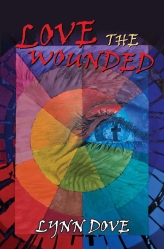
Love the Wounded the third and final book in the trilogy was awarded the Literary Classics prestigious Seal of Approval as well as the Silver Medal for faith-based fiction.
seal of approvalCover Design for Love the Wounded“Love the Wounded” by Lynn Dove is the final and dramatic conclusion to her brilliant Wounded Trilogy series that has followed the lives of teenagers Jake, Leigh, Mike, Dylan and Tim as they come to terms with a series of tragedies and events that have made each of them question why God allows “bad things to happen to good people”.

Leigh does not know who to choose…her heart tells her she will always love Jake, but he has changed so much since the death of their friend, Ronnie, and with his mother going through breast cancer, he has totally closed himself off from her emotionally. Now she is dating Dylan and try as she might to accept him for who he is, she can’t stop thinking about Jake!

Dylan has never gotten over the loss of his father and little sister, killed by a drunk driver when he was just a young boy.

After a horrific accident that has put both Tim and his little brother, Evan in the hospital, everyone knows that not only is he being bullied at school; he cuts himself to cope with it all. But meeting Cassidy has given him the courage to stand up to the bullies and at the same time give her what she so desperately needs…a life-giving bone marrow transplant.

Jake’s mother keeps telling him that “God works all things out for good” but with all the things going on in his life and with his friends, he’s just not sure anymore. It is only after Mike is paralyzed in a car accident that Jake was partially responsible for that all the families and friends will be brought back together, not by coincidence, but by God’s design and then Jake will finally believe that God truly does “Love the Wounded”.

“A life of working with youth has inspired Lynn Dove, a Cochrane mother to turn her experiences into a book trilogy…(the Wounded Trilogy) series that parallels the struggles of students…(and) covers the angst of some of the real serious issues that teenagers face today, particularly with bullying and gossip. ” -Rocky View Weekly-

Love the Wounded can be found on Amazon.com and Amazon.ca, on Lynn's blog Journey Thoughts and wherever fine books are sold!